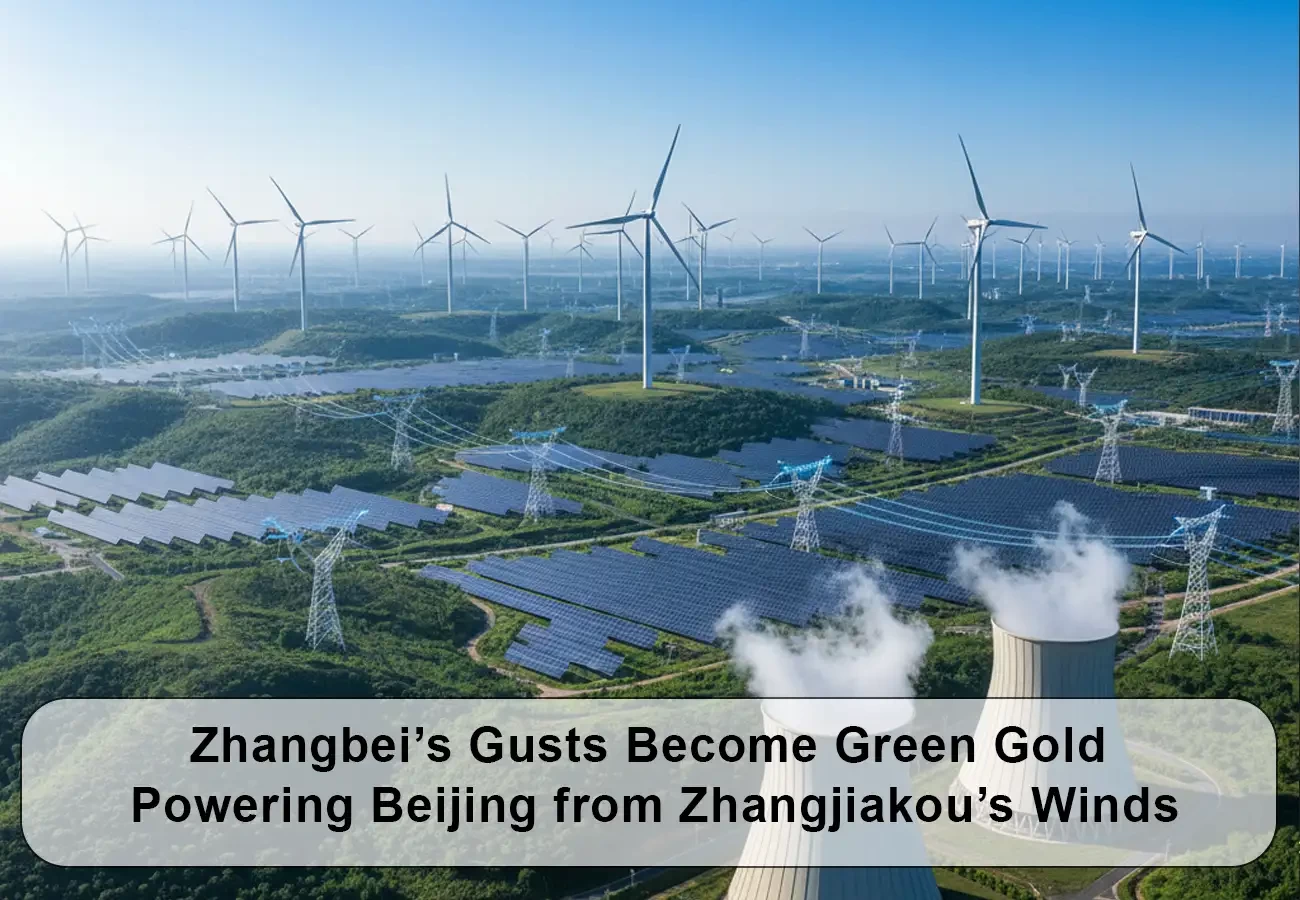

Zhangbei's Gusts Become Green Gold Powering Beijing from Zhangjiakou's Winds
Zhangjiakou in Hebei Province, China, is preparing to host multiple events for the 2022 Winter Olympics. The city’s sports venues are being built steadily, showing how quickly the city is developing. Zhangjiakou sits between the North China Plain and the Inner Mongolia Plateau, exposing it to strong, constant winds year-round. Locals often describe the winter wind as ‘wind that goes on and on from winter to spring’.
While harsh, this wind is a valuable resource. The National Energy Bureau estimates that Zhangjiakou’s wind energy reserves reach around 40 million kilowatts (kW) annually, accounting for over 70% of Hebei Province’s onshore wind resources. The city also benefits from abundant solar energy, with usable solar power estimated at more than 30 million kW per year.
Renewable Energy Development and Challenges in Zhangjiakou
China’s renewable energy policy, first released in 2005, encouraged wind power development. With abundant natural resources, Zhangjiakou has rapidly developed its wind energy sector. By the end of 2019, renewable energy capacity in the city had reached 13.6 million kW, making it a national leader.
However, challenges remain. Local consumption is lower than generation, and external transmission channels for renewable energy were historically limited. In 2014, Zhangjiakou’s energy grid had a maximum load of only 1.85 million kW, with less than 4 million kW of external transmission capacity. Without the proper infrastructure and technology, much of the wind power remained untapped.
China faces two big challenges in using renewable energy on a large scale. First, wind and solar power are unpredictable, wind turbines mostly generate electricity at night when demand is low, making it hard to balance with other energy sources. Second, many renewable energy plants are in rural or suburban areas, far from cities where electricity is needed most. To make the most of these energy resources, electricity must be transmitted efficiently over long distances.
Innovative Technology Drives Power Transmission
Flexible High-Voltage Direct Current (HVDC) transmission is an effective way to send electricity over long distances. It is compact, works well in different environments, and helps integrate renewable energy into the power grid. The Zhangbei HVDC project, approved in late 2017 and launched in February 2018, is the world’s first HVDC system with such high voltage and capacity. It transmits power at ±500 kV across 666 kilometers, connecting Zhangbei, Kangbao, Fengning, and Beijing via four interlinked converter stations. The system can transmit up to 9 million kW of clean energy.
The converter valves at these stations, which connect direct and alternating current, are key to the system’s success. Wang Ke, an engineer at NR Electronic Power Electronics, explains: “If you think of the converter valve as the engine of a car, the water-cooling system for the valve becomes the vehicle’s cooling system. If there are any issues with the cooling system, the entire automobile will not be able to run”. Grundfos’ end-suction pumps supply coolant efficiently, ensuring smooth operation of the valves and overall project success.
With four NKG pumps operating simultaneously, the water-cooling system handles 3,000 tons of water per hour, roughly the size of 1.5 swimming pools. Along with the 12 main pumps, Grundfos supplied auxiliary pumps that support the cooling system for circuit breakers and other equipment. These pumps are a key part of the project, working much like the equipment in waste water treatment plants, industrial wastewater treatment systems, and ultrafiltration plants, where accurate water flow control is essential.
Clean Energy Powers Sustainable Development
On December 27, 2019, the Zhangbei HVDC project began commissioning. Providing a much better way to transmit Zhangjiakou’s planned 20 million kW of renewable power, it effectively manages wind and solar energy. Supporting China’s goal of a low-carbon, green Olympics, this ensures the 2022 Winter Olympics venues run entirely on clean energy.
Grundfos’ water-cooling technology guarantees the annual delivery of 22.5 billion kWh of clean energy, roughly one-tenth of Beijing’s yearly consumption. The project reduces the need for 7.8 million tons of standard coal, cutting 20.4 million tons of CO₂ and 58 million tons of NOx emissions. By integrating these advanced systems, the project enhances both commercial and ecological outcomes for Beijing and Zhangjiakou.
The Zhangbei project demonstrates a model similar to advanced ultrafiltration plants and waste water treatment plants, where reliable water handling, monitoring, and treatment components are critical for large-scale operations. Each part of the water-cooling system mirrors the careful design and modularity found in water treatment plant components, ensuring efficiency and safety. The project also emphasizes industrial wastewater treatment principles, ensuring smooth operation under high loads.
Wang Ke adds: “The Zhangbei project has created twelve world firsts. We are very honoured to provide a cooling system with Grundfos technology for this project. This project brings together our latest and most advanced technologies in the field of flexible HVDC transmission, benefiting our company and the entire industry. We look forward to continuing to innovate and improve our technologies to better support grid development for the future."
Using advanced technology alongside strong industrial wastewater treatment practices, the Zhangbei project shows how renewable energy and water management can work together on a large scale, turning harsh natural conditions into reliable, green energy for cities like Beijing. It is a clear example of how ultrafiltration plants, waste water treatment plants, and precise water treatment plant components can support large infrastructure projects efficiently and sustainably.