
Saudi Arabia Adopts Grundfos Boosters for Major Security Campus Upgrades
The Challenge
The King Abdullah bin Abdulaziz Project (KAP2) was launched by Saudi Arabia’s Ministry of Interior to upgrade 44 military and security facilities across five regions of the Kingdom, as part of a nationwide modernization program.
Each site includes a wide range of new infrastructure such as medical centres, training facilities, shooting ranges, laboratories, villas, auditoriums, mosques, and sports complexes. Together, these developments cover more than 3.5 million square meters of construction area, making KAP2 one of the most significant government infrastructure projects in the region.
A project of this scale needed a better water distribution system that could manage changing demand across many buildings and zones. Daily operations, safety systems, and smooth facility management required stable water pressure for the Ministry. At the same time, the project team wanted a modern water treatment solution that would support efficient water distribution while keeping energy consumption under control.
Initially, constant-speed booster systems from another supplier were installed at several sites. However, these systems proved to be inefficient and inflexible when dealing with changing demand patterns. As a result, the Ministry’s consultant, NKY Design and Project Management, began evaluating alternative technologies that could deliver better performance and long-term reliability. The goal was to integrate advanced water treatment components and intelligent pumping systems capable of operating efficiently in high-security environments with minimal maintenance.
The Solution
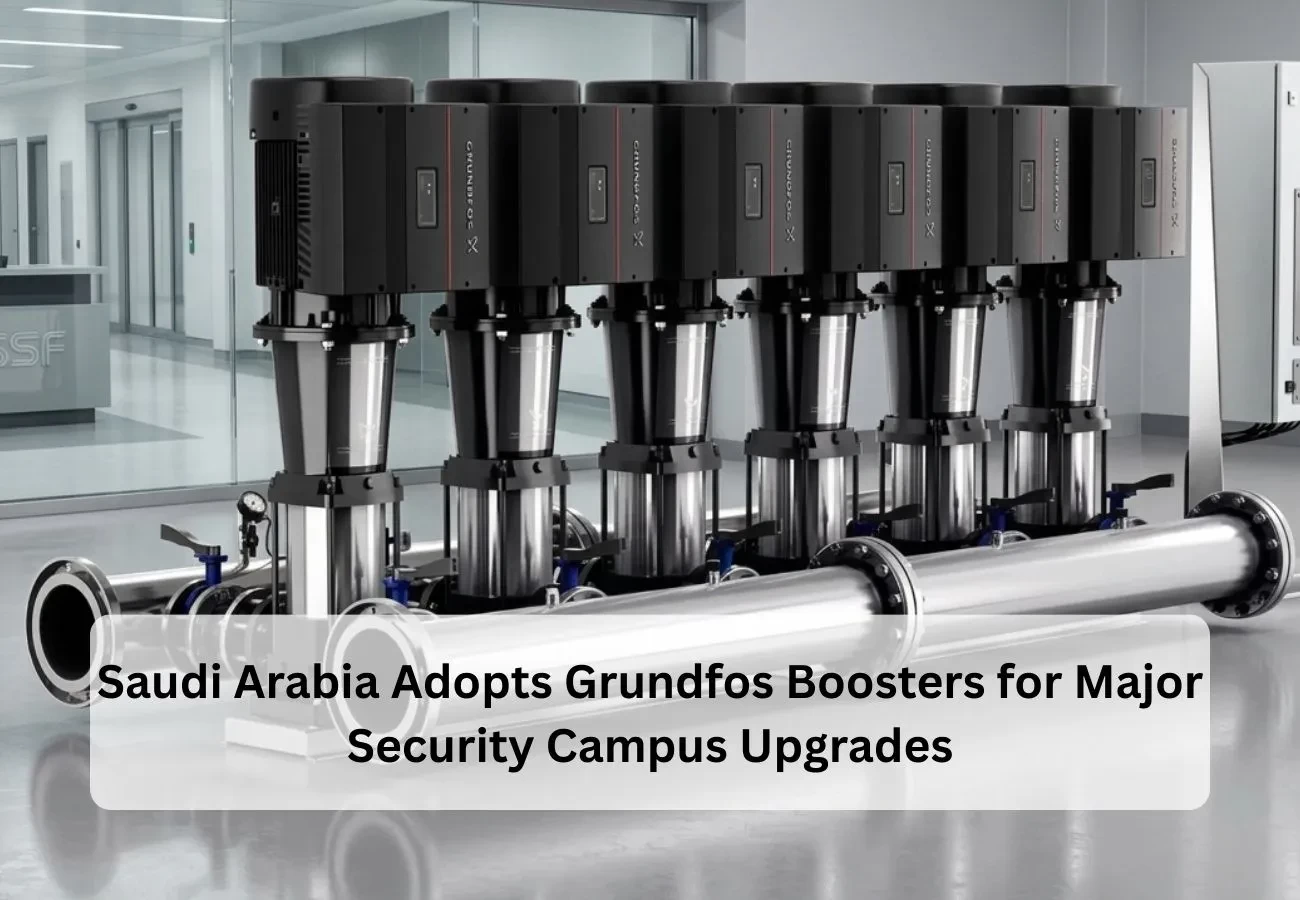
To meet these requirements, Grundfos Saudi Arabia introduced its MPC-E variable-speed booster systems. These systems incorporate advanced Grundfos E pumps, designed to deliver intelligent pressure control while optimizing energy consumption across large water networks.
Each booster set includes a Grundfos CU352 controller, which enables proportional pressure control and friction loss compensation. These functions allow the system to automatically adjust pump performance based on real-time demand. By doing so, the installation ensures steady water pressure while preventing unnecessary energy use and reducing the risk of leaks within the distribution network.
Another important feature is the soft pressure build-up mechanism integrated within the Grundfos E pumps. The pumps start smoothly, thus avoiding the possibility of pressure surges that could cause water hammer in large water distribution systems. Stability in operation is also improved through the incorporation of modern water treatment equipment, such as intelligent controllers and speed drives.
To demonstrate the benefits of the new solution, Grundfos conducted an Energy Check on one of the newly constructed facilities. The building had previously relied on 14 fixed-speed pumps that consumed large amounts of electricity during peak operation. After the installation of the MPC-E system powered by Grundfos E pumps, the performance improvements were clear.
The results included:
- Energy savings: Over 123,000 kWh per year
- CO₂ reduction: More than 87 tonnes annually
- Cost savings: Around €9,000 per year in electricity expenses
When efficient pumping technology is paired with the right water treatment solution, operating costs can decrease, and overall system performance can improve. With these findings, NKY Design and Project Management approved the installation of 121 MPC-E booster sets across all KAP2 project locations.
The Results
The transition to Grundfos MPC-E systems provided the Ministry of Interior with a reliable and energy-efficient infrastructure upgrade. With experienced Grundfos pumps suppliers, the team was able to ensure that all the systems met the required performance and security criteria.
The new systems are now used across various sites and provide consistent water pressure despite varying demands.
Their intelligent control systems help facility managers monitor pump performance and maintain system stability across large campuses.
Additionally, the use of modern water treatment parts enables effective water distribution, as well as minimizing future maintenance. This makes it suitable for use in large government facilities, as reliability is of utmost importance.
Today, the KAP2 modernization program stands as an example of how advanced pumping technologies and a well-designed water treatment can transform critical infrastructure. Through collaboration with trusted Grundfos pumps suppliers, the Ministry has successfully implemented a system that improves efficiency, lowers environmental impact, and supports the growing demands of modern security facilities.
FAQ
- How does Grundfos solve the water pressure issue in the KAP2 project?
Grundfos installs MPC-E variable speed booster systems with Grundfos E pumps. These pumps adjust speed based on water demand and maintain stable pressure across buildings.
- Why are Grundfos booster systems more efficient than earlier pumps?
Earlier constant speed pumps use more energy. Grundfos systems adjust pump speed according to demand, which improves efficiency and reduces energy use.
- How do Grundfos E pumps prevent water hammer in large systems?
Grundfos E pumps start gradually with a soft pressure build up. This reduces sudden pressure surges and helps prevent water hammer.
- How do Grundfos systems help reduce energy costs in large facilities?
Grundfos systems use advanced pump technology to improve efficiency. This reduces electricity consumption and lowers operating costs.