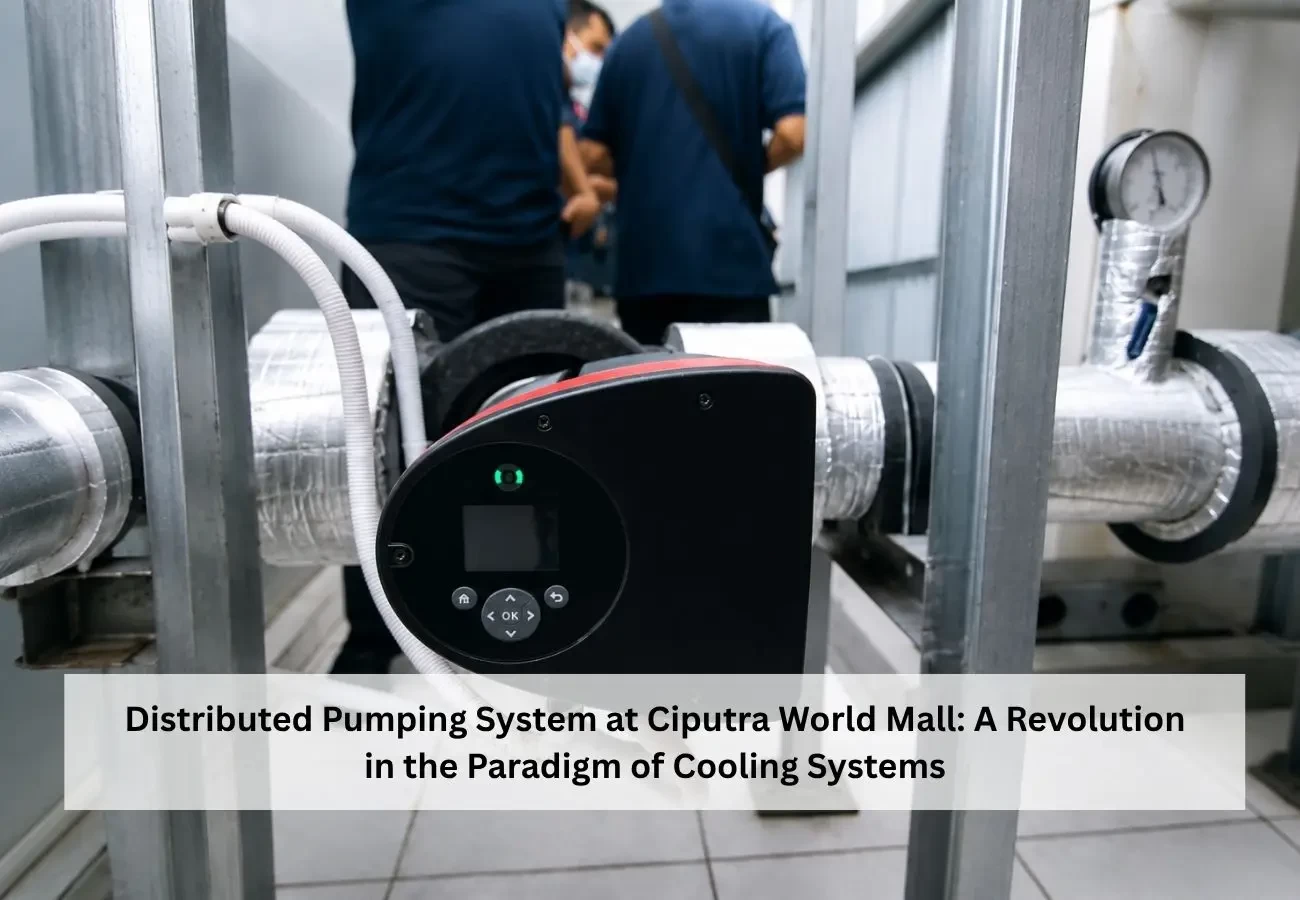

Distributed Pumping System at Ciputra World Mall: A Revolution in the Paradigm of Cooling Systems
Cooling systems in contemporary commercial buildings must be dependable and energy-efficient. Adopting a distributed pumping concept can greatly increase performance while lowering energy consumption, as the Ciputra World Mall project shows. Similar energy-efficiency principles are also applied in modern water treatment plant India projects and advanced RO water treatment plant installations, where reducing operating costs is a main objective.
The Situation
A traditional cooling system with four 90 kW chilled water pumps was part of the original Ciputra World Surabaya design. This setup was efficient, but it used a lot of energy.
The management of the mall desired to investigate a more sophisticated solution that would lower operating expenses and be compatible with contemporary, energy-efficient chiller plant technologies. Improving cooling performance while reducing power consumption was the obvious objective.
The Solution
The engineering team developed a Distributed Pumping System to overcome this difficulty. This creative idea was created to optimize energy use while more precisely matching the building's cooling demand.
Four primary chilled water pumps, each rated at 30 kW, were used in place of the original configuration in the new design, which resulted in more than 50% energy savings over the earlier consultant's design.
The installation comprised 51 pump units in total:
- The chiller system has four main pumps.
- 45 Air Handling Unit (AHU) secondary pumps
- Two Fan Coil Unit (FCU) secondary pumps
The secondary pumps were made up of:
- Twenty-four MAGNA3 pumps
- 23 TPE pumps
Each cooling zone can function independently thanks to this distributed arrangement, which improves temperature control and minimizes energy waste. A similar distributed approach is increasingly used in large-scale reverse osmosis plant facilities and high purity water system applications, where multiple pumping zones improve operational efficiency and process control.
The Result
There were notable gains in performance. The distributed pumping system achieved 0.015–0.018 kW/RT, while conventional systems usually operate in the range of 0.02–0.025 kW/RT. This demonstrates the new solution's increased efficiency.
Stakeholders in the project also emphasized the advantages:
- Increased adaptability in operations
- Simpler control of the system
- Regular temperature inside
- decreased total energy usage
- Increased HVAC dependability
Because of the installed pumps' ease of use and energy-saving benefits, contractors observed that the distributed pumping concept would be a useful reference for future projects. The same focus on energy efficiency is seen in sectors such as industrial wastewater treatment, waste water treatment plant operations, and advanced water treatment solution projects, where pumping systems contribute significantly to overall energy consumption.
Conclusion
Distributed pumping systems are revolutionizing conventional cooling techniques, as demonstrated by the Ciputra World Mall project. This method establishes a new benchmark for commercial HVAC applications with significant energy savings, enhanced temperature control, and scalable design.
For Grundfos pump solutions and expert guidance, contact Alantech — the authorized distributor of Grundfos pumps.
Frequently Asked Questions
Q1: What is a distributed pumping system?
A1: A distributed pumping system uses multiple smaller pumps placed closer to individual cooling zones instead of relying on a few large central pumps, and this improves efficiency, control, and energy savings.
Q2: How does distributed pumping reduce energy consumption?
A2: The system supplies only the amount of flow required for each zone, reducing unnecessary pump operation, and this helps lower power usage and operating costs compared to conventional pumping arrangements.