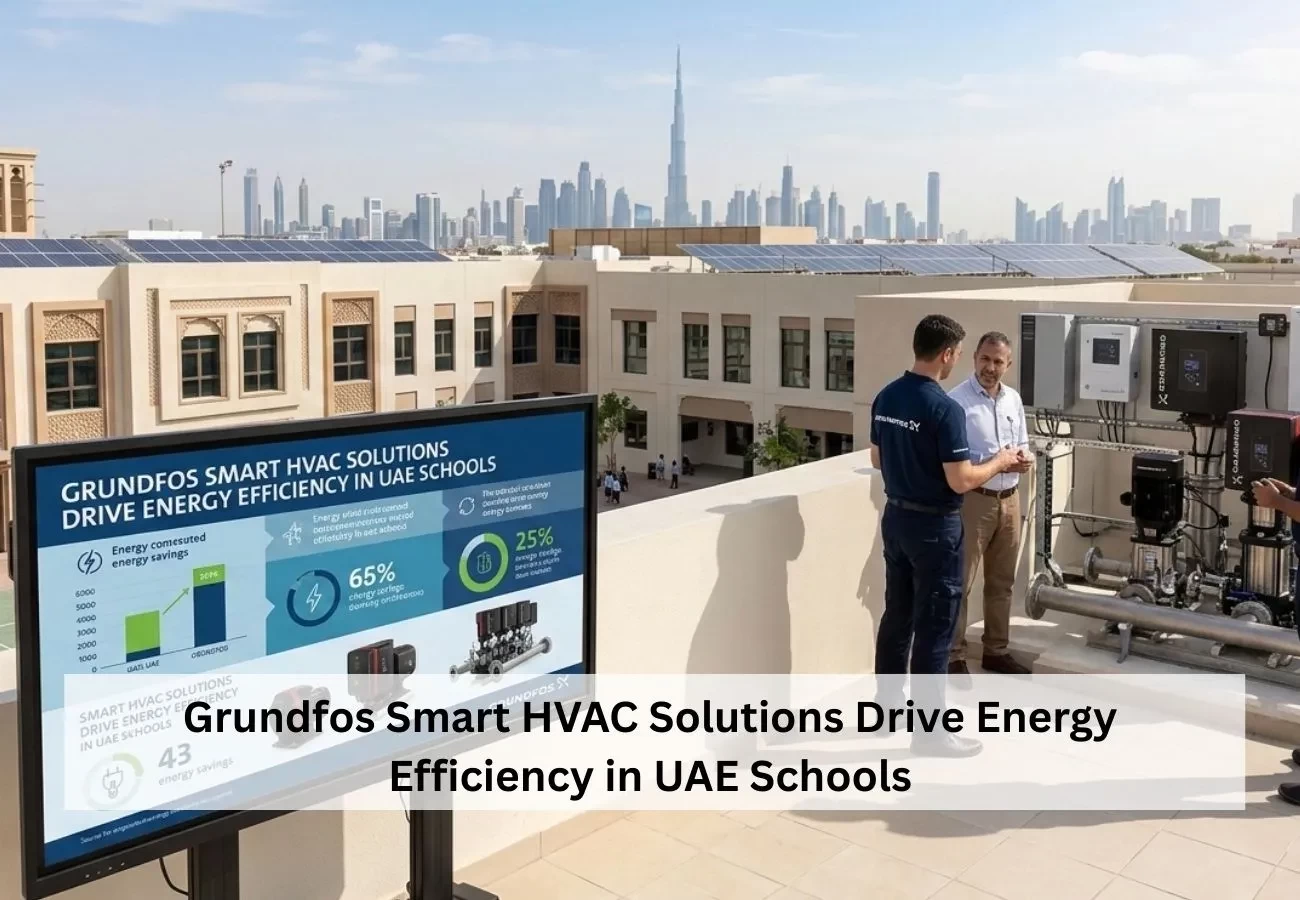

Grundfos Smart HVAC Solutions Drive Energy Efficiency in UAE Schools
The Situation
Three of the top educational institutions in the UAE were experiencing operational issues in their primary and secondary chilled water systems. Although the HVAC system was operational, it was not functioning at its best. The most problematic area was identified in the pump arrangement of the secondary chilled water system. The pumps used were oversized for the actual cooling load, resulting in constant cavitation and unnecessary stress on the mechanical components.
During an in-depth technical assessment, the engineering team observed that the pumps were operating well away from their Best Efficiency Point (BEP). If pumps operate beyond their ideal efficiency curve, there is a drastic reduction in efficiency. This not only leads to an increase in electricity consumption but also causes an increase in the rate of wear and tear of bearings, seals, and impellers. This inefficiency leads to an increase in maintenance costs and a reduction in the reliability of the system.
The institutions had also observed an increase in energy costs without any corresponding increase in cooling demand. The classrooms, laboratories, and administrative buildings needed a constant level of thermal comfort, but the system was using more energy than required to maintain the desired temperature levels. The mismatch between the system design and actual operational requirements was the cause of the inefficiency.
Further investigation revealed that the main factors contributing to the problem were the misapplication of pump sizing and the absence of intelligent control.
The system was designed based on the peak theoretical loads rather than actual operational requirements. Consequently, the pumps were subjected to partial load operation with excessive throttling.
The Solution
To regain operational stability and improve energy efficiency, Grundfos developed a pumping solution suited to the actual cooling demands of the schools. The strategy focused on maximizing hydraulic performance rather than mere replacement.
The first critical step involved resizing the pumps to accurately reflect the site requirements for flow and pressure. By installing properly sized Grundfos E pumps, the system could run much closer to its Best Efficiency Point. Proper sizing of the pumps prevented unnecessary energy consumption due to over-supply of flow and prevented cavitation.
Apart from the mechanical resizing, sophisticated controls were also incorporated to improve responsiveness. Frequency drives offered by the project’s ESCO partner were seamlessly interfaced with the Grundfos CU352 controller. This smart control module allows for real-time modulation, which enables the pumps to vary their speed according to the cooling load.
With this setup, the system could react instantly to changes such as occupancy, outdoor temperatures, and class usage. Rather than operating continuously at a set speed, the pumps varied their output to provide only the amount of flow needed. This resulted in a substantial reduction in wasted energy.
The integration of Grundfos E pumps with smart controllers also improved system diagnostics. Real-time monitoring provided data on pressure, flow, energy consumption, and operating efficiency. This allowed facility managers to make data-driven decisions and detect performance deviations before they escalated into mechanical failures.
A comprehensive Energy Audit was also conducted to quantify baseline consumption and estimate potential savings. The audit also revealed other areas of optimization, which included the adjustment of balancing valves, hydraulic distribution, and scheduling. These ensured that the whole chilled water system was working in a coordinated manner and not in standalone components.
Through collaboration with approved Grundfos pumps suppliers, it was ensured that the installation, commissioning, and verification of the pumps were done as per the required standards. Alignment, hydraulic balancing, and calibration of the system were critical to ensure reliability.
The Outcome
The replacement of outdated oversized pumps with right-sized Grundfos E pumps delivered immediate and measurable improvements in HVAC performance. Energy consumption dropped significantly across all three campuses, leading to noticeable reductions in electricity bills.
Because the new pumps operated near their Best Efficiency Point, mechanical stress decreased substantially. The problems of cavitation were eliminated, the levels of vibration were reduced, and the noise in the system was improved. The frequency of maintenance was reduced because the equipment experienced less wear, leading to longer intervals between maintenance and lower costs of ownership.
The stability of the system was also improved. The chilled water system had stable pressure and flow rates despite the changes in the load. Classrooms and facilities experienced reliable thermal comfort without the fluctuations previously caused by unstable pump performance.
Through the ESCO performance contract model, the schools did not require upfront capital investment. All the costs involved in the upgrade, such as equipment costs, installation costs, maintenance costs, and spare parts, were taken care of by the guaranteed energy savings. This made upgrading a cost-effective option.
Partnering with professional Grundfos pumps suppliers ensured that the process of integrating the systems was done correctly, and technical support services were available. The schools not only benefited from energy savings but also from long-term performance assurance.
Long-Term Impact on Educational Facilities
Energy efficiency in educational institutions directly impacts operational budgets. The money saved from the optimized HVAC systems can now be allocated to academic resources, technology, and student programs.
Through the implementation of intelligent pumping systems, the institutions were able to improve their sustainability index while minimizing carbon footprint. The reduced electricity usage directly correlates to the minimized greenhouse gas emissions, which is in line with the sustainability objectives of the UAE.
The success of this project proves that well-engineered pumping systems, in conjunction with experienced Grundfos pumps suppliers, can turn the existing HVAC infrastructure into a high-performance, energy-efficient system.
Rather than accepting the high cost of energy as a reality, the schools used technology, engineering, and intelligent pump control to develop a stable, efficient, and financially viable cooling system.
Frequently Asked Questions (FAQ)
- Why were the original pumps causing high energy consumption?
The original pumps were oversized and operating far from their Best Efficiency Point. This caused excessive energy use, hydraulic imbalance, and cavitation, reducing overall system efficiency.
- How do smart pumps improve HVAC efficiency?
Smart pumps are capable of adjusting their speed based on the real-time cooling requirement. This helps to avoid energy wastage during low loads and maintains system stability.
- What is the benefit of operating near the Best Efficiency Point (BEP)?
Operating near BEP maximizes pump efficiency, reduces mechanical stress, minimizes vibration, and extends equipment lifespan while lowering electricity costs.
- How does an ESCO performance contract benefit institutions?
An ESCO contract allows upgrades to be financed through guaranteed energy savings. Institutions avoid upfront investment, and modernization costs are recovered through reduced utility bills.