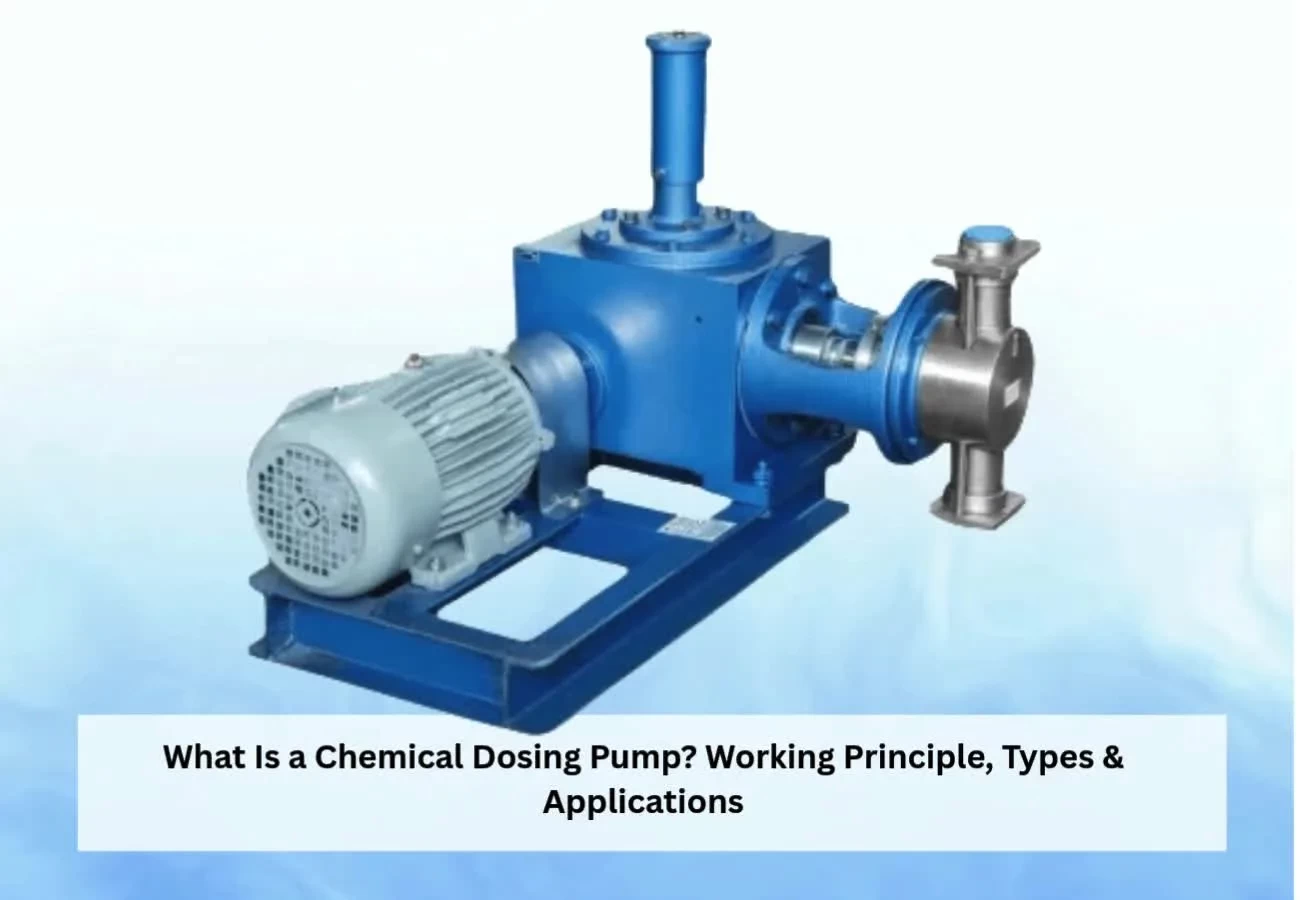

What Is a Chemical Dosing Pump? Working Principle, Types & Applications
A chemical dosing pump is a mechanical device that injects a precise, controlled volume of chemical into a liquid, gas or steam flow. It's used to adjust pH, disinfect water, prevent scaling or add treatment chemicals at a set rate. Most designs rely on a diaphragm, piston or peristaltic mechanism to push measured doses through, one stroke or rotation at a time.
Key Takeaways
- A chemical dosing pump works by moving a fixed, repeatable volume of liquid with each stroke or cycle.
- The three most common types are diaphragm, piston and peristaltic pumps.
- Choosing the right chemical dosing pump depends on chemical compatibility, flow rate needed and how corrosive the fluid is.
- A well-set-up chemical dosing system reduces chemical waste and keeps dosing consistent, which matters for both cost and compliance.
What a Chemical Dosing Pump Actually Does
Picture a tank of chlorine solution feeding into a municipal water line. Somebody needs to control exactly how much chlorine goes in, every minute of every day, without a person standing there with a measuring jug. That's the job a chemical dosing pump does. It draws chemical from a storage container and pushes it into a pipe or vessel at a rate you've set, whether that's litres per hour or millilitres per stroke.
Dosing pumps have been used in industrial and municipal settings for decades, and the underlying working principle hasn't shifted much, even as the electronics controlling them have gotten smarter. If you're comparing dosing equipment for your own site, we have put together a broader overview of dosing systems and how to choose between them, which might be worth reading alongside this one.
How Does a Chemical Dosing Pump Work?
The chemical dosing pump working principle comes down to displacement. Rather than pumping a continuous stream like a centrifugal pump would, a dosing pump moves fluid in small, repeated, measured amounts. Each stroke or rotation moves a controlled volume of fluid, and the total dose depends on the pump's displacement and operating speed.
The Basic Cycle
- A motor or actuator drives a diaphragm, piston or rotor.
- On the intake stroke, chemical is drawn from the supply tank through a check valve.
- On the discharge stroke, that same volume is pushed out through a second check valve into the process line.
- The cycle repeats at whatever frequency the control settings call for.
Because each cycle moves a known amount, operators can calculate dosing rates with a fair degree of confidence, adjusting stroke length or speed to fine-tune the output without swapping equipment.
Types of Chemical Dosing Pumps
There isn't one universal design, and the differences between types matter quite a bit depending on what you are dosing.
- Diaphragm Pumps
A flexible diaphragm moves back and forth to create suction and discharge while separating the pumped chemical from the pump's drive mechanism. This keeps the fluid path sealed, which is why diaphragm pumps are the go-to choice for corrosive or hazardous chemicals. They dominate the market for good reason, and fewer seals to wear out, less risk of leakage, and decent accuracy across a wide dosing range.
- Piston Pumps
These use a piston moving inside a cylinder to push fluid through. Piston pumps tend to handle higher pressures than diaphragm models, which makes them useful in industrial settings that need to inject chemicals against significant backpressure, such as certain oilfield or boiler applications.
- Peristaltic Pumps
Here, a rotor squeezes fluid through flexible tubing, and the chemical never touches any pump internals beyond the tube itself. This makes cleaning and chemical changeovers simple, which is one reason peristaltic pumps are gaining ground quickly in pharmaceutical and food-grade dosing, where hygiene matters as much as accuracy.
- Solenoid-Driven Pumps
A solenoid-driven diaphragm pump uses an electromagnetic pulse rather than a motor-driven crank. These tend to be compact and reasonably priced, making them common for smaller-scale dosing tasks like residential water treatment or small commercial pools.
Comparison of Common Pump Types
| Pump Type | Best For | Handles Corrosive Chemicals | Typical Precision |
| Diaphragm | General chemical injection, water treatment | Yes | High |
| Piston | High-pressure industrial dosing | Moderate | High |
| Peristaltic | Pharmaceuticals, food-grade, easy cleaning | Yes | Moderate to High |
| Solenoid-driven | Small-scale or residential dosing | Moderate | Moderate |
Where Is a Chemical Dosing Pump Used?
Chemical dosing pump applications stretch across a surprising number of industries, though a handful of sectors account for most of the demand.
- Water and wastewater treatment, where dosing pumps add chlorine, coagulants or pH adjusters, remains the largest single application area globally.
- Oil and gas operations use them for corrosion inhibitors and scale prevention in pipelines.
- Food and beverage processing relies on them for controlled cleaning agent dosing and preservative addition.
- Pharmaceutical manufacturing depends on precise dosing during formulation and blending stages.
- Swimming pools and cooling towers use smaller units to maintain chemical balance without constant manual checking.
Why Water Treatment Leads the Way?
Regulations around clean drinking water and safe wastewater discharge have only got stricter over the years, and that pushes utilities toward equipment that can prove consistent, documented dosing. A chemical injection pump that logs its output and holds a steady rate gives operators exactly that kind of paper trail, which matters during inspections and audits.
Choosing the Right Pump for Your Application
A few practical questions help narrow things down before you buy anything.
- What chemical are you dosing, and how corrosive or viscous is it?
- What flow rate and pressure does your process actually need?
- Do you need remote monitoring or manual adjustment only?
- How often will the pump run, and what's your maintenance capacity?
Getting these answers sorted first saves you from buying a pump that's either overqualified for a simple job or underpowered for a demanding one.
Conclusion
A chemical dosing pump does one job, and it does it repeatedly: move a measured amount of chemical into a process at a controlled rate. The type you choose, whether diaphragm, piston, peristaltic or solenoid-driven, depends mostly on the chemical involved and how demanding your process conditions are. Water treatment remains the biggest user of this technology, but the same working principle applies whether you're running a municipal plant or a small commercial pool.
If you are setting up or upgrading a chemical dosing system and want guidance on which pump type suits your process, get in touch with Alantech. The team at Alantech can help you understand your requirements and point you toward equipment that actually fits.
Frequently Asked Questions (FAQs)
Q1: What is the main difference between a chemical dosing pump and a regular pump?
A1: A chemical dosing pump is designed to deliver a controlled and repeatable amount of chemical at a specified flow rate, while a general-purpose pump is primarily designed for fluid transfer rather than precise chemical dosing.
Q2: Which type of chemical dosing pump is best for corrosive chemicals?
A2: Diaphragm pumps are generally the preferred choice for corrosive chemicals because the fluid never contacts moving mechanical parts directly, reducing wear and leak risk.
Q3: Can a chemical dosing pump be automated?
A3: Yes, most modern dosing pumps can be linked to sensors and controllers so the dosing rate adjusts automatically based on readings like pH or chlorine levels.
Q4: How long does a chemical dosing pump typically last?
A4: With regular maintenance and correct chemical compatibility, a well-built dosing pump can run reliably for several years before major parts need replacing.