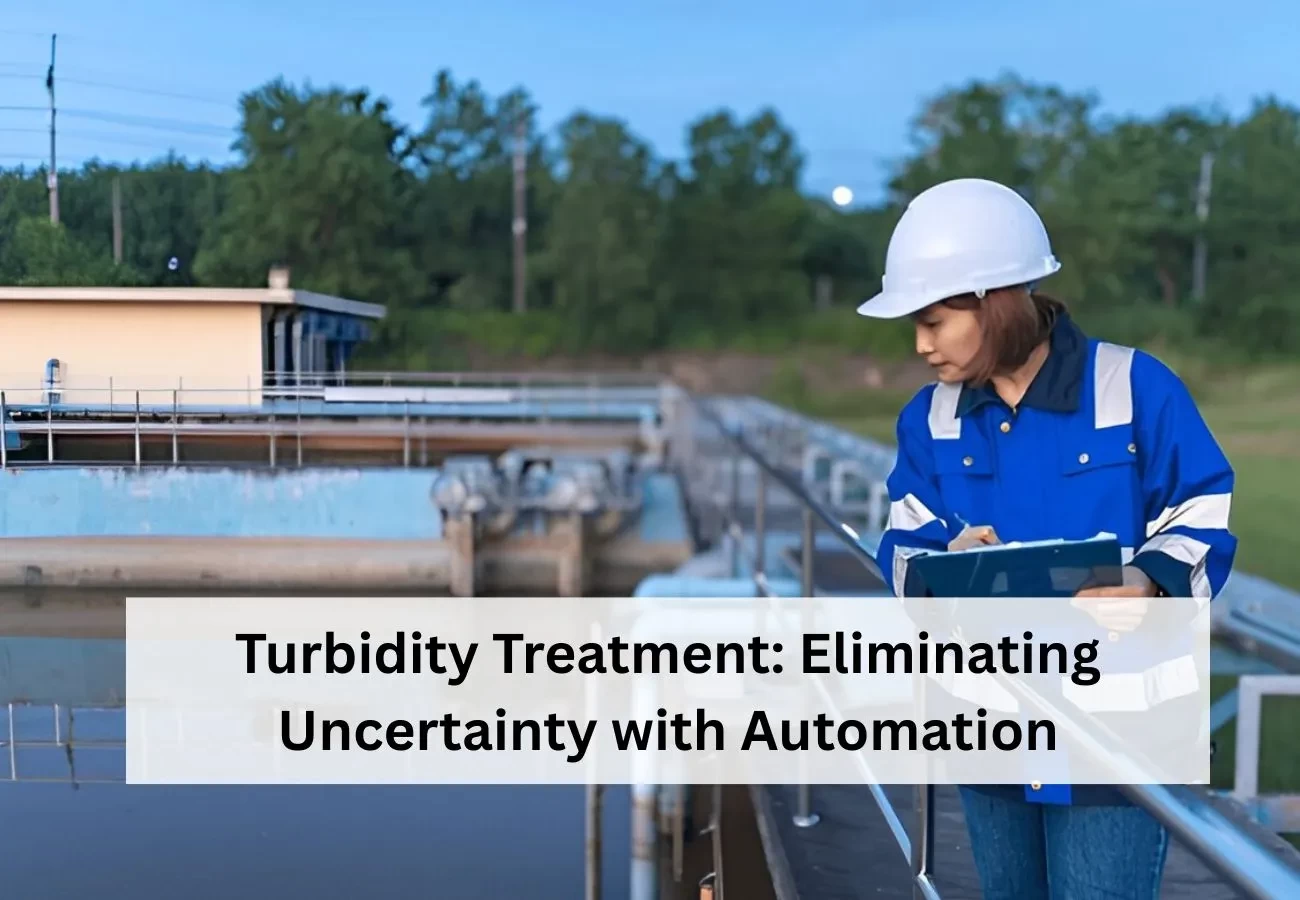

Turbidity Treatment: Eliminating Uncertainty with Automation
Maintaining clear and stable water quality has never been simple, especially in facilities that depend on a raw water treatment plant to manage unpredictable water conditions. Turbidity levels can change within minutes due to rainfall, soil movement, or seasonal activity, and every shift influences the stages that follow in a raw water treatment plant. When the clarity of incoming water reduces, the filters work less effectively, chemical use increases, and the entire setup demands more attention from operators. Many operators rely on manual adjustments to compensate for these changes, but manual responses often come too late, leading to inconsistency and a great deal of operational stress.
This is why many industries today are rethinking the way turbidity is managed, and why automation has become a key advantage. As one of the trusted water treatment plant manufacturers, Alantech focuses on practical, real world needs and develops systems that respond faster and far more accurately than traditional manual methods.
Understanding the Core Problem
When turbidity in raw water increases, the first visible impact is a drop in clarity. But beneath this simple observation lies a chain of performance issues. High turbidity disrupts sedimentation, overloads filters, increases backwash frequency, and reduces the lifespan of vital water treatment plant components. Operators often try to counter this by increasing chemical dosing, but manual dosing has its own limitations.
Manual systems depend on constant visual observation and operator judgment. If turbidity rises sharply, operators may not react quickly enough. If they increase dose rates too much, coagulant wastage and overloading occur. If the dose is too low, suspended solids pass through to the next stage. Both situations lead to inconsistent treated water quality and rising operational costs.
Even backwash cycles become difficult to manage without automation. Many facilities perform backwashing on fixed schedules or whenever operators guess it is needed. This can result in:
- Delayed backwash
- Excessive pressure drop
- Filter clogging
- More frequent failures
Why Turbidity Creates a Bigger Challenge Than Expected
Turbidity is dynamic. It changes rapidly and sometimes unpredictably. A sudden shift in river quality, canal water, borewell disturbance, or plant intake conditions can cause turbidity to spike within moments. This unpredictability demands constant monitoring and fast corrective actions.
The challenge becomes even more complex when you consider the number of interconnected water treatment plant components that turbidity affects. Every stage of the process depends on the clarity of the incoming water. If turbidity is high:
- Sedimentation efficiency drops.
- Filters work harder and clog faster.
- Energy consumption increases due to repeated pumping and backwashing.
- Downstream purification, including advanced waste water treatment systems, suffers.
Chemical use also increases. Excess chemical consumption not only affects budgets but also impacts downstream mechanical parts. Many industries discover that their equipment wears out faster simply because their manual turbidity adjustments are inconsistent.
And because these operations depend heavily on operator skill and availability, any gap in monitoring can worsen the situation immediately. This is why industries increasingly look for solutions that minimize dependency on manual routines.
The Solution: Intelligent Automation for Turbidity Control
Automation brings consistency to areas where manual operation often fails to maintain steady performance. Intelligent turbidity control systems track turbidity levels at every moment through dependable sensors that read water quality in real time. Using this information, the system manages coagulant dosing with accurate and timely adjustments.
Automated dosing prevents under dosing and over dosing, ensuring each drop of chemical is used efficiently. This is particularly valuable for industries where chemical costs form a major share of operating expenses.
In a modern raw water treatment plant, automation also supports the filtration stage. Programmable filtration cycles allow water to flow through all stages of a raw water treatment plant under consistent conditions. Backwashing is automatically initiated by the system based on differential pressure or scheduled time intervals. This reduces the risk of filter blockage, lowers downtime, and ensures treated water quality remains steady day after day.
Sensors and automated controls make it possible to maintain high clarity, even when incoming water changes frequently. This continuity is essential for industries that depend on reliable output to run downstream systems or waste water treatment systems efficiently.
How Alantech Delivers This Automated Advantage
Alantech integrates advanced PLC and SCADA control systems into its treatment solutions, allowing any raw water treatment plant to be upgraded into a fully automated and intelligent system. Turbidity sensors communicate directly with dosing pumps, filtration units, and backwash mechanisms to maintain precise and coordinated operation.
This approach is one of the reasons Alantech is counted among dependable water treatment plant manufacturers in the industry. The company focuses on real performance, long term reliability, and simple user experience. Every system is designed to operate consistently without unnecessary operator involvement.
Here is how Alantech creates value:
- Real time dosing optimization
Coagulant dosing adjusts instantly to maintain stable turbidity.
- Automated filtration management
Filtration cycles use programmable logic to maintain flow, clarity, and pressure.
- Smart backwash initiation
Backwashing triggers only when necessary, saving water and reducing filter strain.
- Reduced chemical and operational costs
Precision dosing and optimized cycles reduce daily operating costs.
- Component friendly operation
Steady operations extend the life of water treatment plant components.
- Minimal manual involvement
Automation lowers reliance on operator skill, reducing errors.
Alantech offers reliable solutions for modernizing waste water treatment systems and water management.
Why Automation Transforms Industrial Water Treatment
Automation does more than simplify turbidity management. It improves long term performance across an entire plant. Stable turbidity ensures smooth downstream processes, protects water treatment plant components, and keeps energy use and chemical dosing consistent.
Facilities that adopt automated turbidity systems report smoother workflows, lower operational costs, and greater consistency in output quality. For any industrial raw water treatment plant, these benefits accumulate over time, leading to substantial savings.
Automation also makes scaling easier. Industries that plan to expand or upgrade their treatment capacity find it easier to integrate new systems when the existing infrastructure is already operating under stable automated conditions.
Conclusion
Controlled turbidity and robust waste water treatment systems enable a fully automated, low-maintenance solution.
This is the kind of stability industries gain when working with experienced water treatment plant manufacturers like Alantech. With custom engineered solutions, advanced monitoring tools, and smart automation, Alantech ensures clear, reliable, and stable water output around the clock.