How Does an SWRO Plant Work? Pre-treatment, Membranes and Energy Recovery for UAE Seawater
How Does an SWRO Plant Work? Pre-treatment, Membranes and Energy Recovery for UAE Seawater
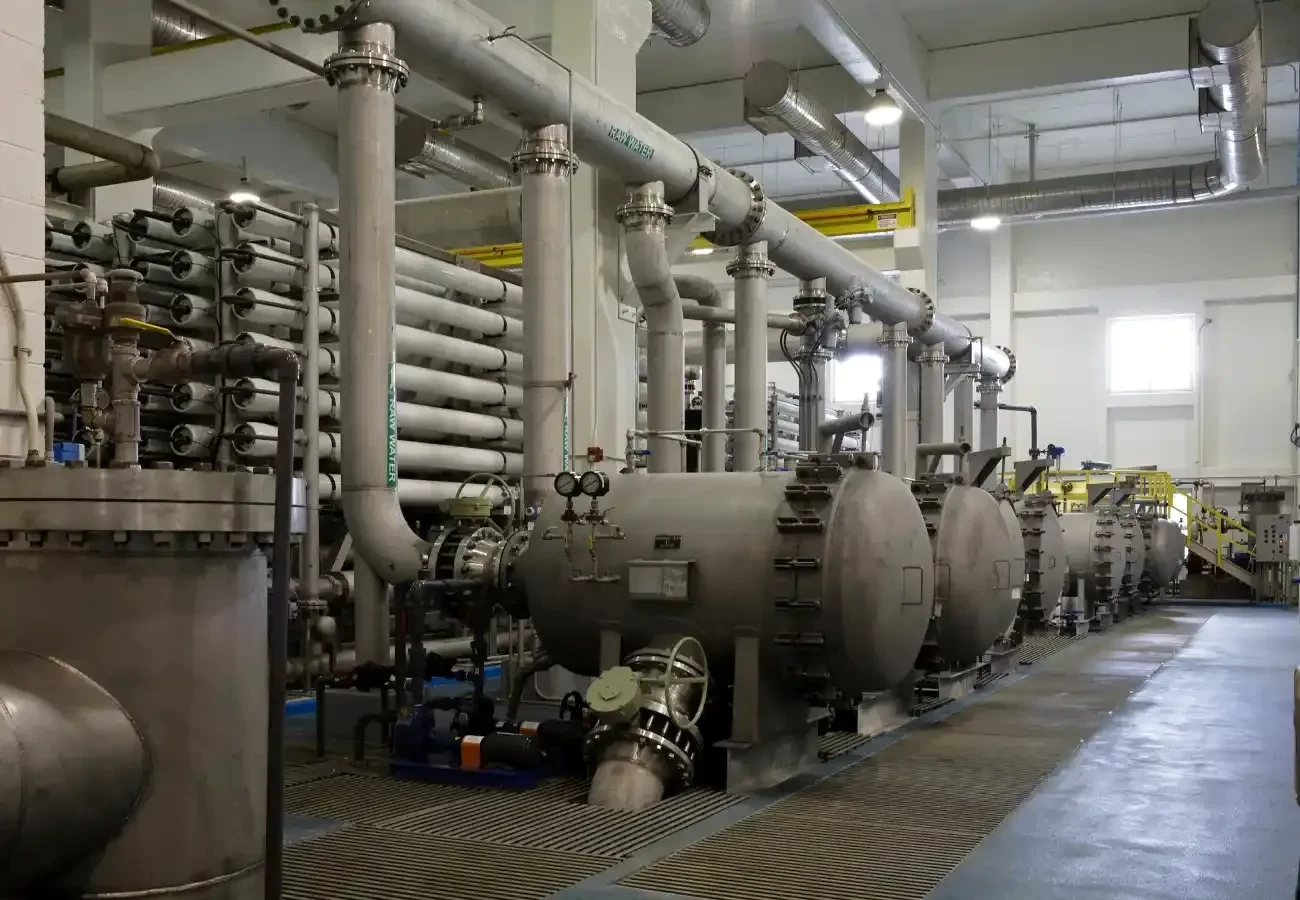
A seawater reverse osmosis plant turns seawater into drinking water in three main stages. Pre-treatment cleans the incoming seawater, high-pressure pumps push it through SWRO membrane elements that hold back the salt, and energy recovery devices return much of the pressure to the system.
Key Takeaways
- Pre-treatment protects the membranes, so it shapes how long the plant runs well and how much it costs to operate.
- The SWRO membrane separates salt from water under high pressure.
- Gulf seawater is saltier than the global average, so feed pumps commonly work at 55 to 70 bar.
- Energy recovery devices reuse pressure from the leftover brine and lower the power needed per cubic metre.
- Post-treatment rebalances minerals and disinfects the permeate before it reaches storage and distribution.
- The UAE already draws about 42% of its drinking water from desalination, and reverse osmosis is taking a larger part of that supply.
A sea water reverse osmosis plant looks simple on a flow diagram, yet each stage depends on the one before it. This blog follows the water from the intake pipe to the storage tank, explaining what happens at every step and why Gulf conditions call for careful design. At Alantech, we look at the three stages together when planning a plant, because a change in one area affects the others. For a broader overview, see how seawater desalination turns sea water into drinking water. The sections below cover pre-treatment, membranes, energy recovery, finishing steps and the questions we hear most from plant owners.
How a Seawater Reverse Osmosis Plant Works
The SWRO desalination process relies on one natural principle in reverse. Normally, fresh water moves through a thin barrier towards saltier water. When enough pressure is applied to the salty side, the direction flips, and fresh water passes through the barrier while the salt stays behind.
Gulf seawater usually holds around 40 to 45 grams of salt per litre, higher than the global average of roughly 35. That level of salinity means the pumps work at high pressure, commonly between 55 and 70 bar. The design of the whole SWRO plant follows from this one fact.
The Three Stages in Order
- Pre-treatment: removes particles, algae and organic matter from the feed water
- Reverse osmosis: separates fresh water from salt using membranes
- Energy recovery and post-treatment: reuses pressure from the brine and prepares the water for drinking
In the UAE, this matters at the national scale. According to a French Institute of International Relations (Ifri) study from 2022, 42% of the country's drinking water comes from desalination plants. The UAE government has also stated that more than half of its desalinated water will come from reverse osmosis by 2036, as noted by the UAE Ministry of Foreign Affairs.
Pre-treatment: Preparing the Seawater
Seawater carries sand, silt, algae and dissolved organic matter. Membranes have very fine openings, so the feed water needs to arrive clean. Good pre-treatment extends membrane life, and the other stages benefit from it too.
Intake Design
Plants draw water either through an open sea intake or through beach wells under the seabed. Open intakes are common on the UAE coast and need screens to hold back fish, shells and weed. Beach wells deliver water already filtered by the sand, which reduces the work later in the plant, though the site geology has to suit it.
Filtration Steps
Coarse Screening
Bar screens and fine screens at the intake remove larger material first. This step is simple, and it keeps pumps and pipes in good condition.
Media Filters
Media filters pass the water through beds of sand, anthracite or similar material. The Dubai Electricity and Water Authority (DEWA) describes a dual media filter at its Jebel Ali plant that improves the quality of the feed water and extends the life of the membranes, according to a Dubai Media Office report.
Cartridge Filters
Cartridge filters act as the final guard before the high-pressure pumps. They collect the finest particles that pass through the media beds, usually down to about five microns.
Chemical Conditioning
Small doses of coagulant help fine particles gather into larger clusters that filters collect more easily. Antiscalant keeps dissolved minerals in solution so they stay clear of the membrane surface. Operators adjust the dosing as the seawater changes through the seasons, since algae levels and temperature shift between summer and winter.
SWRO Membrane: Where the Salt Is Separated
The SWRO membrane is a thin polymer sheet rolled into a spiral-wound cylindrical element. Several elements sit in a pressure vessel, and the high-pressure feed water flows along them. Roughly 40 to 50% of the feed becomes fresh water, which is called permeate. The remainder leaves as concentrated brine.
Modern membranes reject more than 99% of the dissolved salt in a single pass. Many plants add a second pass to reach lower salinity levels, which suits industrial users and certain drinking water targets. The NYU Abu Dhabi Water Research Center has also built a reverse osmosis membrane module locally, as The National reported in December 2024, which points to growing local expertise.
Membrane Care
Regular monitoring of pressure difference, flow and salt passage shows when a membrane needs cleaning. Scheduled chemical cleaning restores performance, and most membranes serve for 5 to 7 years when feed water quality stays steady.
Energy Recovery: Reusing Pressure
The brine leaving the membranes still carries most of the pressure applied to it. An energy recovery device captures that pressure and passes it to the incoming feed water, so the main pump only supplies the balance.
Pressure exchangers are the most widely used design today. They transfer pressure directly from brine to seawater in a rotating ceramic cylinder. DEWA reports that the recovery devices at its Jebel Ali plant reach 96% efficiency, as stated in the same Dubai Media Office report.
The result shows up in electricity use. The Ifri study mentioned earlier puts the typical figure for reverse osmosis desalination at 2.5 to 3 kWh per cubic metre of water, with the best Saudi plant recorded at 2.27 kWh. Thermal methods need considerably more.
Post-treatment and Storage
Permeate is very pure, so it needs finishing before it reaches homes. Operators raise the pH, add calcium and magnesium for taste and pipe protection, and apply disinfection. The water then moves to storage tanks and into the distribution network.
Stage-by-Stage Comparison
| Stage | Main Equipment | Purpose | Effect on Plant Performance |
|---|---|---|---|
| Pre-treatment | Screens, media filters, cartridge filters | Remove particles and organic matter | Longer membrane life |
| Reverse osmosis | High-pressure pumps, membrane vessels | Separate salt from water | Water quality and output |
| Energy recovery | Pressure exchangers | Reuse brine pressure | Lower power use |
| Post-treatment | Dosing units, tanks | Balance minerals and disinfect | Safe, pleasant drinking water |
Reverse Osmosis Desalination Plants in the UAE
Reverse osmosis desalination plants across the Emirates now range from municipal facilities serving whole cities to smaller units for hotels, industrial sites and islands. Each SWRO desalination plant is sized against local demand, available power and the quality of the nearby seawater. Output, intake type and number of membrane passes all follow from those inputs.
Points to Review Before Planning
- Seawater analysis across all seasons, including temperature, salinity and algae levels
- Daily water demand and expected growth
- Power supply and the option of solar input
- Brine discharge arrangements and local marine guidelines
- Operator training and spare parts supply
Reviewing these factors early helps the design team develop a system that meets the site's operating requirements.
Conclusion
A seawater reverse osmosis plant works well when its three stages are planned as one system. Pre-treatment keeps the feed water clean, the membranes separate the salt, and energy recovery returns pressure to the process. For UAE sites, where seawater is warm and salty, steady attention to each stage gives reliable output and manageable running costs.
If you are planning a new SWRO plant or reviewing an existing one, we would be glad to help. Contact Alantech to share your requirements.
Frequently Asked Questions (FAQs)
Q1: What is the SWRO desalination process?
The SWRO desalination process removes salt from seawater using pressure and membranes. Seawater is cleaned first, then pumped through reverse osmosis membranes that let water pass and hold back the salt. The fresh water is then treated for drinking.
Q2: How much energy does a sea water reverse osmosis plant use?
A modern sea water reverse osmosis plant uses about 2.5 to 3 kWh of electricity per cubic metre of fresh water, according to the Ifri study cited above. The exact figure depends on seawater salinity, temperature, pump efficiency and the type of energy recovery device installed. Plants with pressure exchangers sit at the lower end of that range, and Gulf sites with warmer water usually need slightly different settings from cooler coasts.
Q3: How long does an SWRO membrane last?
An SWRO membrane commonly lasts five to seven years. Steady feed water quality, good pre-treatment and scheduled cleaning all help it reach the longer end of that range.