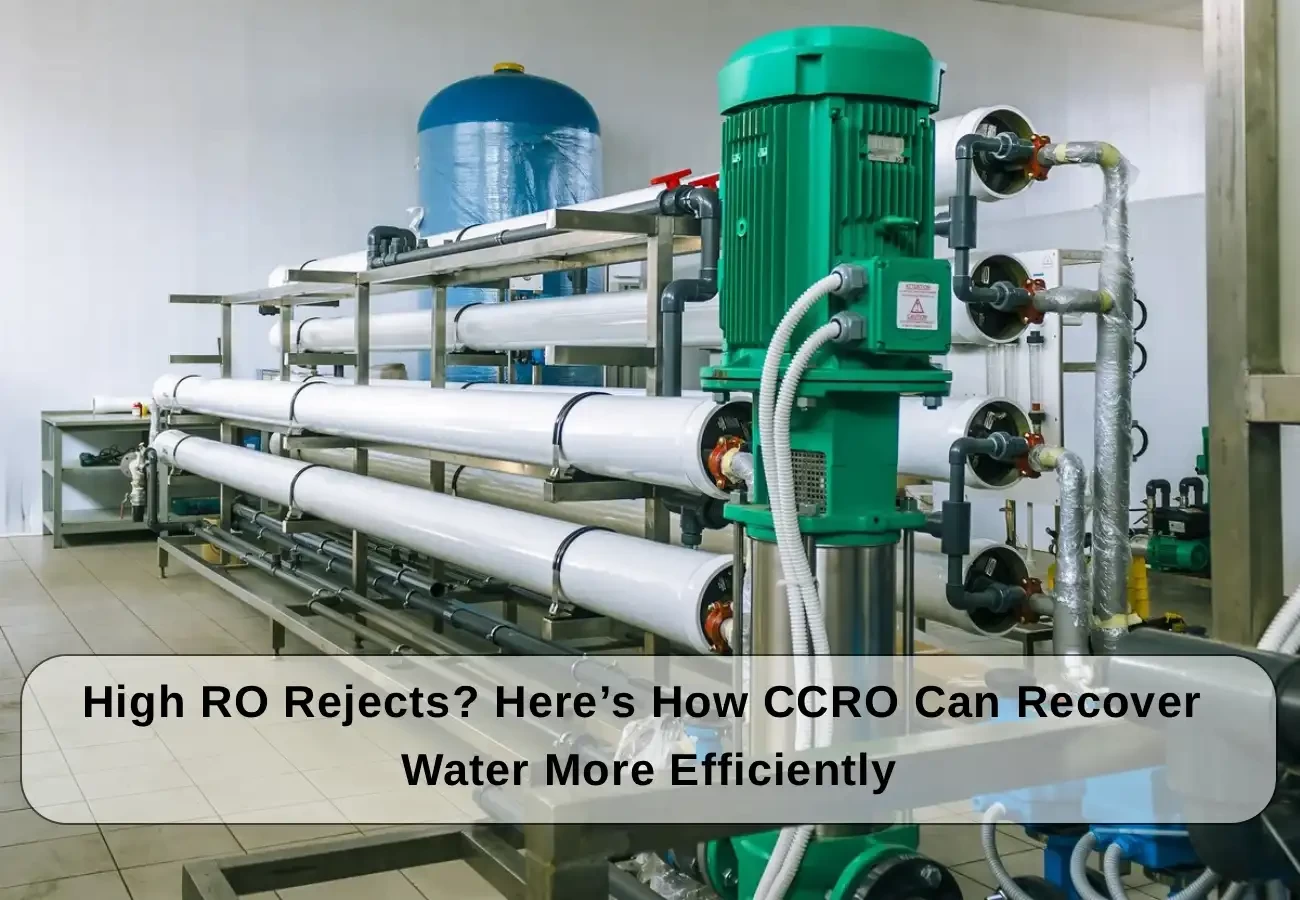

High RO Rejects? Here's How CCRO Can Recover Water More Efficiently
The problem of water wastage from conventional RO systems is becoming a major issue for industries today. Many businesses use Reverse Osmosis systems to purify water, but a lot of water is often discharged as reject water during the process. This, in turn, increases water consumption, operational costs and environmental impact.
CCRO (Closed Circuit Reverse Osmosis) is an advanced solution that helps improve the performance of a reverse osmosis plant by recovering more water and reducing waste, and this can make it an ideal choice for industries moving towards sustainability and resource efficiency.
The Problem with Conventional RO Systems
Typical RO systems operate under steady state conditions, with constant pressure and flow. These systems dump large quantities of concentrate or reject water to prevent scaling and fouling of the membranes.
In many industries, this results in:
- High wastage of water
- Greater reliance on freshwater
- Increased costs of efluent disposal
- Decreased overall system efficiency
Too much reject water can be a significant operational problem for industries where water availability and operating costs are critical. This challenge is commonly faced in facilities operating an RO water treatment plant, particularly where water recovery targets are high.
What Makes CCRO Different?
CCRO technology is different from traditional RO systems. The system does not continuously discharge reject water but operates in a closed-loop circulation process. Water is circulated within the membrane circuit until the maximum amount of water is recovered and only a small volume of concentrate is discharged.
This sophisticated process enables industries to reclaim much more usable water from the same feed.
Benefits of CCRO Technology
Increased Water Recovery
The high efficiency of recovery is one of the biggest advantages of CCRO. Conventional RO systems might recover 60-75% of feed water, while CCRO systems can achieve recovery rates greater than 90% depending on water quality.
Which means:
- Less water lost
- The production of more purified water
- Better use of resources at hand
Reduction of operating costs
By minimizing reject water, industries can reduce:
- Costs of water bills
- Cost of disposing wastewater
- Use of chemicals Losses of energy
This in turn translates into significant savings in plant operation over time.
Membrane fouling is lower
The CCRO controlled circulation process reduces scaling and membrane fouling. This extends the life of the membrane, reduces the need for maintenance and enhances the reliability of the whole system.
Water management that is sustainable
CCRO provides support to industries that aim to meet sustainable operations and water conservation objectives. It is of great benefit to companies seeking to reduce their environmental impact and
improve their water reuse practices.
CCRO Applications
The CCRO systems are heavily used in:
- Food and Beverage industries Breweries Pharmaceuticals
- Textile industry
- Bottled water factories
- Treatment of industrial process water
Better recovery and less wastage can be of great help to industries dealing with high water consumption. CCRO is also increasingly integrated with industrial waste water treatment and waste water treatment systems to improve overall plant efficiency and reduce freshwater demand
Conclusion
High RO reject water loss doesn't have to be accepted as a normal part of industrial operations anymore. CCRO technology provides an efficient and sustainable solution to maximize water recovery, reduce operating costs and improve plant performance.
Alantech offers state-of-the-art CCRO and water treatment solutions customized for industrial applications. Our systems are built to help industries operate more efficiently, sustainably and reliably over the long term.
Frequently Asked Questions
Q1: What is CCRO, and how is it different from a conventional RO system?
A1: CCRO (Closed Circuit Reverse Osmosis) recirculates water within the membrane system instead of continuously rejecting concentrate, and this allows much higher water recovery than a conventional reverse osmosis plant.
Q2: Which industries benefit the most from CCRO technology?
A2:Industries such as food and beverage, pharmaceuticals, textiles, bottled water production, and industrial waste water treatment plants benefit from CCRO because it reduces water consumption and operating costs.
Q3: Can CCRO support zero liquid discharge goals?
A3: Yes. CCRO can significantly reduce reject water, making it an effective pre-treatment technology for zero liquid discharge water treatment and ZLD water treatment systems that aim to maximise water reuse.