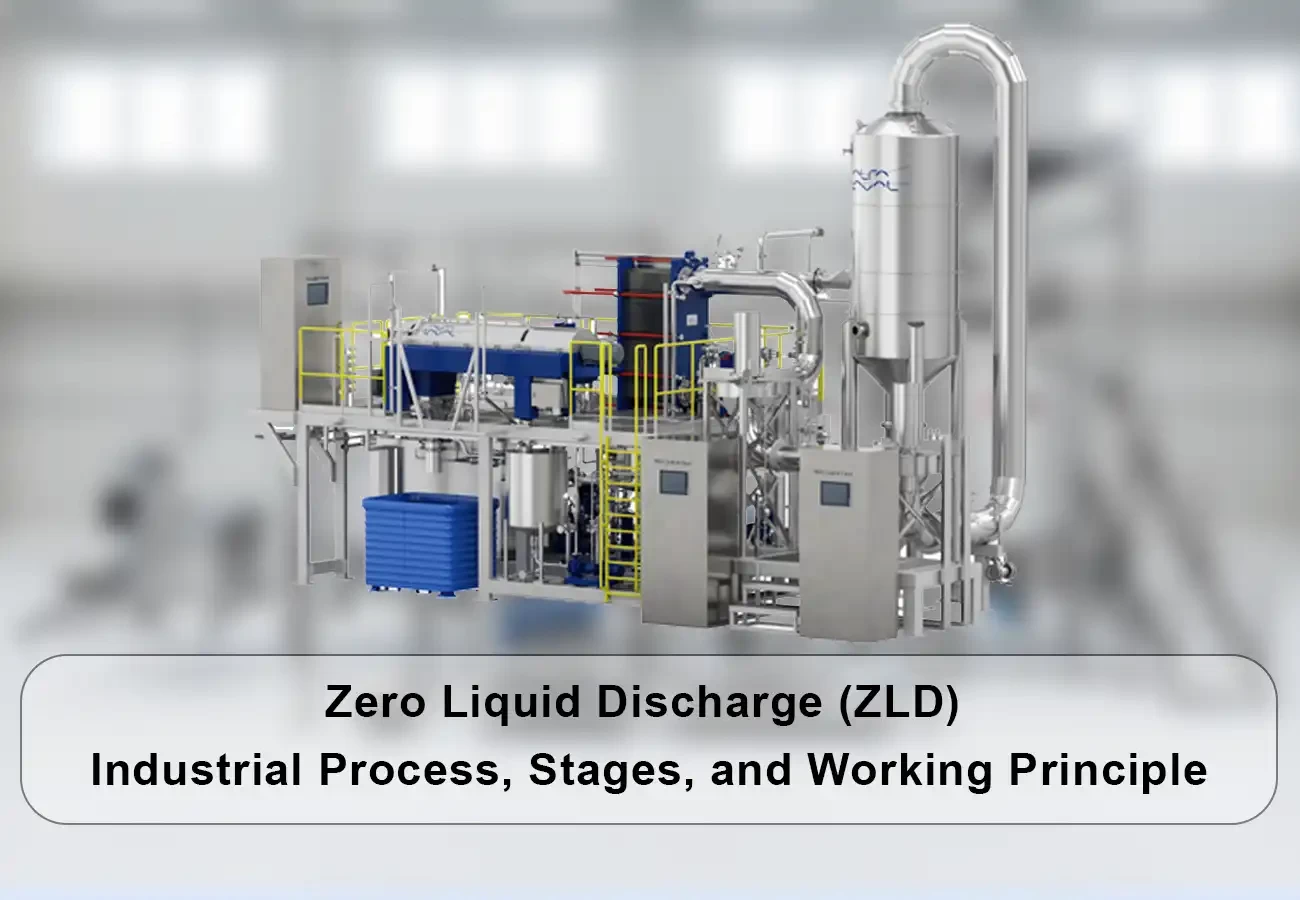

Zero Liquid Discharge (ZLD): Industrial Process, Stages, and Working Principle
With increasing regulations, water shortages, and rising costs, industries are responsibly choosing wastewater reuse. ZLD systems treat, recycle, and reuse water on-site, promising no liquid waste leaves the facility. This approach not only supports environmental compliance but also strengthens long-term water security for industries operating in water-stressed regions.
At Alantech, we design and implement advanced zero liquid discharge water treatment solutions that help industries recover the maximum amount of water from their processes. Our systems eliminate liquid discharge while maintaining high operational efficiency, reducing environmental impact, and promoting long-term sustainability.
What is Zero Liquid Discharge (ZLD)?
Zero Liquid Discharge is a comprehensive wastewater solution in which all industrial effluent is treated on-site, recycled, and reused within the facility. Instead of discharging liquid waste into external drains or water bodies, industries convert wastewater into reusable water and solid waste for safe disposal.
In a ZLD system:
- Treated water is recovered and reused for production, cooling, utilities, or boiler feed.
- Dissolved salts and contaminants are separated and converted into solid form.
- Final disposal is limited to solids that follow regulatory guidelines.
Unlike conventional treatment methods, ZLD water treatment ensures that industries operate in a closed-loop water cycle. This protects natural water resources while improving process reliability and reducing dependency on freshwater sources.
Why Industries Are Adopting ZLD Systems
Industries are moving toward ZLD systems for both compliance and operational efficiency. As pollution control authorities enforce stricter discharge limits, companies must upgrade the way they manage wastewater.
Key reasons for ZLD adoption include:
- Compliance with CPCB, SPCB, and international environmental regulations.
- Significant reduction in freshwater consumption.
- Stable operations in regions facing water shortages.
- Long-term cost savings through internal water reuse.
- Improved sustainability and ESG performance.
ZLD is no longer only about meeting regulations. It is now a smart investment that supports reliable industrial wastewater treatment while keeping operations running without disruption.
Industrial ZLD Process – Overview
A typical ZLD system uses an effluent treatment plant along with membrane and thermal technologies to recycle industrial wastewater, recovering water for reuse and turning leftover contaminants into solids for safe disposal.
The process integrates multiple stages such as pre-treatment, biological treatment, ultrafiltration (UF), reverse osmosis (RO), evaporation, crystallization, and drying. These stages work together to create a closed-loop water management system, maintaining continuous operation even with changing effluent volumes.
Each step targets specific contaminants for better performance, minimizes fouling, and provides reliable long-term operation for industrial applications.
Stages of Zero Liquid Discharge System
- Pre-Treatment and Effluent Equalization (Primary Treatment)
This initial stage in the ZLD process conditions the wastewater for the next treatment and protects the equipment used in later stages.
Typical units are:
- Bar screening and grit removal.
- Oil and grease traps or separators.
- Equalization tank for flow balancing.
- pH correction and chemical dosing.
- Primary clarifier or DAF system.
The objective is to stabilize hydraulic load and pollutant concentration while preventing scaling, fouling, or damage to membranes and thermal systems. A strong pre-treatment stage improves the overall performance of zero liquid discharge water treatment plants.
- Primary & Secondary (Biological) Treatment
This stage focuses on reducing organic load and suspended solids from wastewater before membrane filtration.
Common technologies include:
- Moving Bed Biofilm Reactor (MBBR)
- ASP (Activated Sludge Process).
- SBR (Sequential Batch Reactor).
- MBR (Membrane Bioreactor).
- Secondary clarifiers.
- Sand Filtration and Activated Carbon Treatment
The goal is to effectively remove BOD, COD, and TSS, allowing the membrane section to operate smoothly and boosting water recovery in ZLD water treatment systems.
- Membrane-Based Water Recovery (UF & RO)
This is the main recovery section of any ZLD plant and plays a critical role in producing reusable water.
Process steps include:
- Ultrafiltration (UF) removes fine particles, colloids, and microorganisms.
- Reverse Osmosis (RO) separates dissolved salts and produces high-quality permeate water for reuse.
Outputs:
- RO Permeate: Reused for manufacturing, utilities, cooling towers, or boiler feed.
- RO Reject: Sent for thermal concentration.
This stage maximizes water recovery and significantly reduces the volume of rejected water requiring further processing in industrial wastewater treatment facilities.
- RO Reject Concentration (Thermal Systems)
The RO reject contains high Total Dissolved Solids (TDS) and must be treated thermally for further water recovery.
Common technologies include:
- Multiple Effect Evaporator (MEE).
- Mechanical Vapor Recompression (MVR).
These systems evaporate water from the reject stream while concentrating salts into a smaller volume. Energy optimization is key at this stage to reduce operating costs while maintaining high recovery efficiency in the overall effluent treatment plant setup.
- Final Water Recovery – Crystallization and Thin Film Drying
The concentrated brine from the evaporator is further processed to eliminate any remaining liquid discharge.
Process outcomes include:
- Condensation of water vapor for reuse.
- Crystallization of salts into solid form.
- Drying of moist solids using Thin Film Dryer (TFD) or similar equipment.
This stage removes all liquid waste and converts the remaining contaminants into solids, finalizing the closed-loop process of zero liquid discharge water treatment.
- Solid Waste Management
The recovered salts and solids are:
- Dewatered and dried.
- Collected and stored safely.
- Disposed of or reused as per regulatory approvals.
Safe solid waste handling ensures compliance, environmental protection, and long-term sustainability for industrial operations.
How a ZLD System Works in an Industrial Plant
Wastewater from different production units is collected and sent to the ZLD system. Through a combination of pre-treatment, biological processing, membrane filtration, evaporation, and drying, contaminants are removed in stages.
Recovered water is reused inside the facility for cooling, processing, and utilities, while dissolved salts are transformed into solid waste. This closed-loop process stops all liquid discharge, ensures compliance with regulations, and promotes responsible industrial wastewater treatment.
Advantages of Alantech ZLD Solutions
Alantech designs ZLD plants that give stable performance under varying effluent characteristics.
Key advantages include:
- High water recovery efficiency.
- Energy-optimized membrane and thermal systems.
- Modular and scalable plant design.
- Automation-ready solutions with minimal manual intervention.
- Compliance with Indian and international standards.
At Alantech, our effluent treatment plant integration focuses on:
- Reliable and efficient pre-treatment processes.
- Energy-saving evaporators and thermal technologies.
- Advanced monitoring, automation, and control systems.
These features promise good performance and long-term value for industries adopting ZLD water treatment solutions.
Conclusion
Zero Liquid Discharge represents a smart investment for industries that choose regulatory compliance, better water management, and long-term sustainability. By treating all wastewater using biological methods, membranes, and thermal processes, industries can stop liquid discharge entirely and reuse water within the facility to the fullest extent.
With advanced industrial wastewater treatment technologies, ZLD reduces environmental impact while improving operational efficiency and water security.
Alantech offers complete ZLD solutions, helping industries move toward zero discharge, higher efficiency, and long-term environmental responsibility.