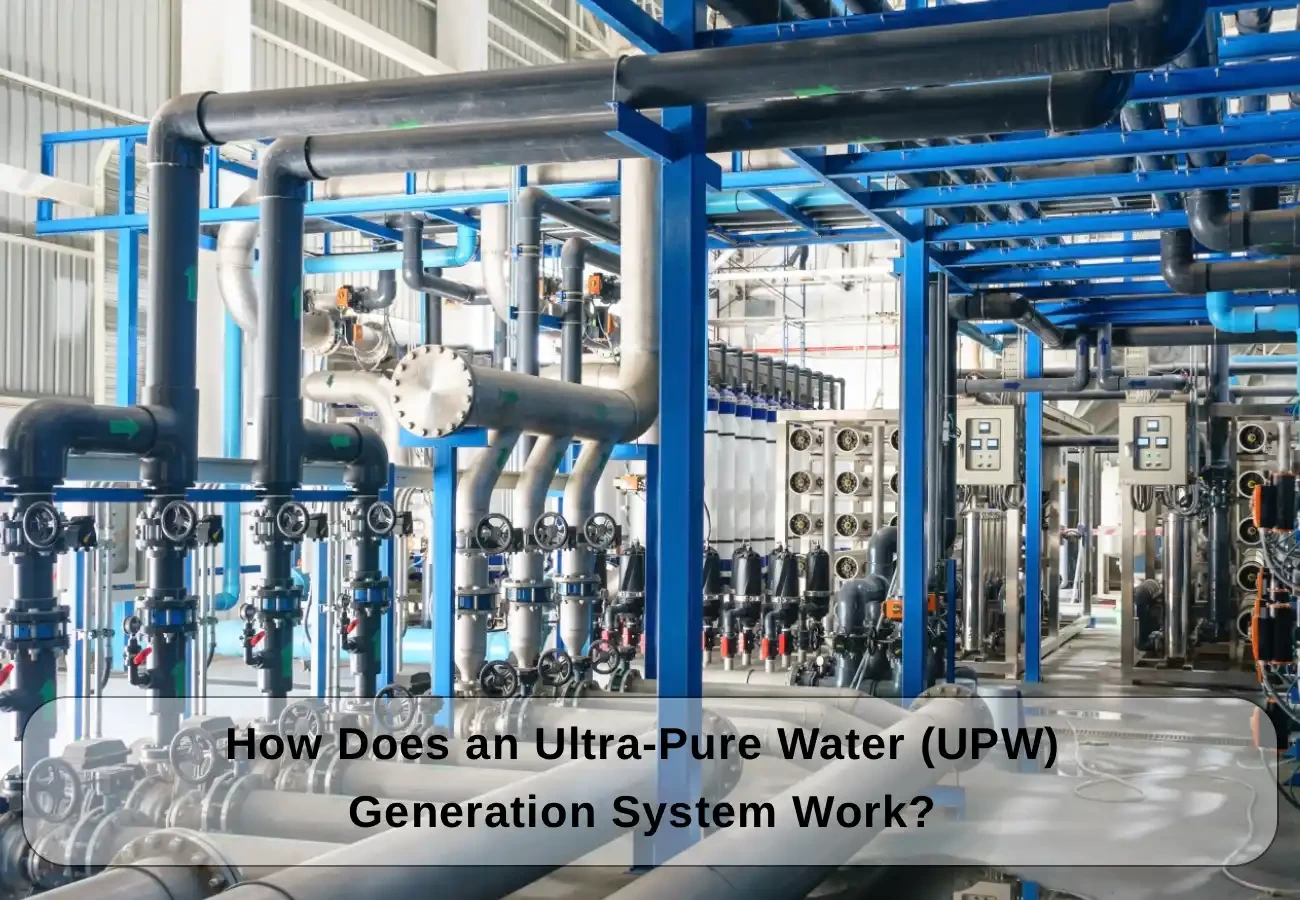

How Does an Ultra-Pure Water (UPW) Generation System Work?
In industries such as pharmaceuticals, semiconductors, biotechnology, food & beverage and cosmetics, water is much more than a utility, it is a critical process ingredient. Even trace amounts of minerals, microorganisms, organic compounds or microscopic particles can impact product quality, reduce equipment life and create costly production losses.
This is why industries depend on Ultra-Pure Water (UPW) Generation Systems where a combination of sophisticated treatment technologies is used to turn raw water into ultrapure water.
But what really happens inside a UPW system?
Let’s go over the process of treatment step by step.
Step 1: Raw Water Collection
All UPW systems start with a raw water source. In this example the feed water is taken from the canal water.
Natural water contains many impurities such as:
- Suspended solids
- Silt and clay
- Organic matter
- Mineral dissolved
- Bacteria and algae
- Heavy metal elements
Compounds producing colour and odour
To generate Ultra-Pure Water, these impurities must be eliminated in multiple steps
Step 2: Coagulation, Oxidation & Clarification
Chemical coagulation and oxidation followed by a clarifier is the first stage of treatment.
Coagulants make fine suspended particles clump together into larger particles called flocs. These heavier flocs settle out in the clarifier leaving cleaner water to go on.
Why is this stage important?
- Removes solids in suspension
- Lowers turbidity
- Removes algae and organic material
- Protects downstream filtration equipment
- Improves overall treatment effectiveness
Without clarification downstream membranes would foul much more quickly.
Step 3: Multimedia Filtration (MGF)
The stored water is then passed through a Multi Grade Filter (MGF).
MGF has many layers of filtration media that filter smaller suspended particles one by one.
This stage removes:
- Fine suspended solids
- Sand
- Silt
- Rust particles
- Residual flocs
Cleaner water entering the membrane systems significantly improves membrane lifespan.
Step 4: Ultrafiltration (UF)
Water goes through the multimedia filter and heads into the Ultrafiltration (UF) system. UF membranes contain microscopic pores that eliminate:
- Bacterial
- Colloids
- fine suspended solids
- Viruses (According to membrane rating)
- Organic compounds of high molecular weight
The process diagram shows a UF recovery of about 93.3%. This means that most of the incoming water is recovered while the contaminants are concentrated into a small reject stream.
Why is UF essential?
Reverse osmosis membranes are very fragile. Membrane pores can even be blocked by microscopic particles.
UF is the protective barrier that enables RO membranes to work efficiently.
Step 5: Reverse Osmosis (RO) – First Pass
The UF permeate enters into the first stage Reverse Osmosis (RO Pass-1) system.
RO uses high pressure to force water through semi-permeable membranes which reject:
- Salts solutions
- Metal
- Nitrates
- Silicon dioxide
- Organic compounds
- Bacterial
- Viruses
The process results in a very good recovery of 85 that is a significant amount of feed water is converted into clean permeate.
The reject stream is still concentrated but still has usable water.
This system catches more water instead of throwing it away.
Step 6: Reject Recovery Reverse Osmosis (RRO)
The Reject Recovery RO (RRO) is one of the most efficient features of this UPW system. The reject from the RO is treated further instead of being sent to drain directly. The RRO system is:
- Recover valuable water from reject stream
- Cuts down on wastewater generation
- Enhances overall recovery of plants
- Conserve water resources
- Reduces operating cost
The process diagram shows that the RRO unit has approximately 70 percent recovery, with the recovered water being recycled back into the treatment process and very little final reject.
This is a wonderful example of sustainable water management.
Step 7: Reverse Osmosis (RO) – Second Pass
Water from RO Pass 1 undergoes further purification in RO Pass 2.
A second RO stage greatly reduces:
- Remaining dissolved salts
- Conductivity
- Silica
- Organic contaminants
- Ionic impurities
The second pass achieves about 90% recovery, producing water that is suitable for final polishing.
Step 8: RO Permeate Storage
Purified RO water is temporarily stored in the RO Permeate Tank.
This provides:
- A steady supply for polishing systems
- Continuous plant operation
- Better process control
Step 9: TOC UV System
Water is purified by TOC UV unit prior to final polishing.
TOC UV is not just another UV disinfection; it is specifically designed to reduce Total Organic Carbon (TOC).
Organic compounds can even impact pharmaceutical and semiconductor manufacturing at very low concentrations.
The UV system:
- Breaks organic molecules down
- Reduces the TOC content
- Prevents microbial growth
- Improves the final UPW quality
Step 10: Electrode ionization (EDI)
The water flows into the Electrode ionization (EDI) system after the UV treatment.
EDI uses electrically charged membranes and ion-exchange resins to remove the last bits of dissolved ions.
Unlike traditional ion-exchange systems:
- Chemical regeneration free
- Continuous operation
- Consistent water quality
- Easy maintenance
- Environment friendly operation
The process diagram indicates a recovery of approximately 95% for EDI, which implies a high operational efficiency.
Step 11: NRMB Final Polishing
The final polishing step is performed using NRMB, which gives a surprising 99% recovery.
In this step any remaining trace ionic impurities are removed to obtain Ultra Pure Water for highly sensitive industrial applications.
This last polishing ensures that:
- Extremely low conductivity
- High resistivity
- Water’s stable chemistry
- Highest process reliability
Step 12: Ultra Pure Water Storage
The finished Ultra Pure Water is held in a hygienically designed UPW Tank. These tanks are normally designed with:
- Stainless steel construction
- Sanitaryware
- Orbital welding
- Closed loop circulation
- Hygiene-minded piping
This prevents contamination and keeps the water quality up to the destination.
Why This UPW System Design Stands Out
The process highlights several major engineering advantages:
- Always multi-stage purification for high quality water
- High recoveries in UF, RO, EDI and polishing final stages
- Reject Recovery RO (RRO) reduces wastewater and increases water reuse
- TOC UV keeps organic contaminants at ultra-low levels
- Continuous polishing provides water suitable for the most demanding industrial applications
- Hygienic storage and distribution to ensure the quality of water until use
Bringing these technologies together in a single engineered solution, industries can achieve exceptional water purity, while reducing operating costs, minimizing water waste, and improving system reliability over the long term.
Conclusion
Producing Ultra Pure Water is not just about installing a Reverse Osmosis unit. It needs a good sequence of clarification-filtration-membrane separation-ion removal-organic reduction and hygienic storage. Each has a particular job and, in combination, they provide the quality of water necessary for essential processes in industry.
Alantech engineers and supplies custom Ultra Pure Water Generation Systems that integrate the latest technologies like Ultrafiltration (UF), Reverse Osmosis (RO), Reject Recovery RO (RRO), TOC UV, Electrodeionization (EDI) and final polishing, to achieve the highest water recovery, lowest operational cost and consistent UPW quality. No matter if your application is pharmaceutical manufacturing, food processing, cosmetics, biotechnology or semiconductor production, our engineered solutions meet the highest standards of purity, efficiency and reliability.
Contact Alantech to discuss a UPW system tailored to your process requirements.