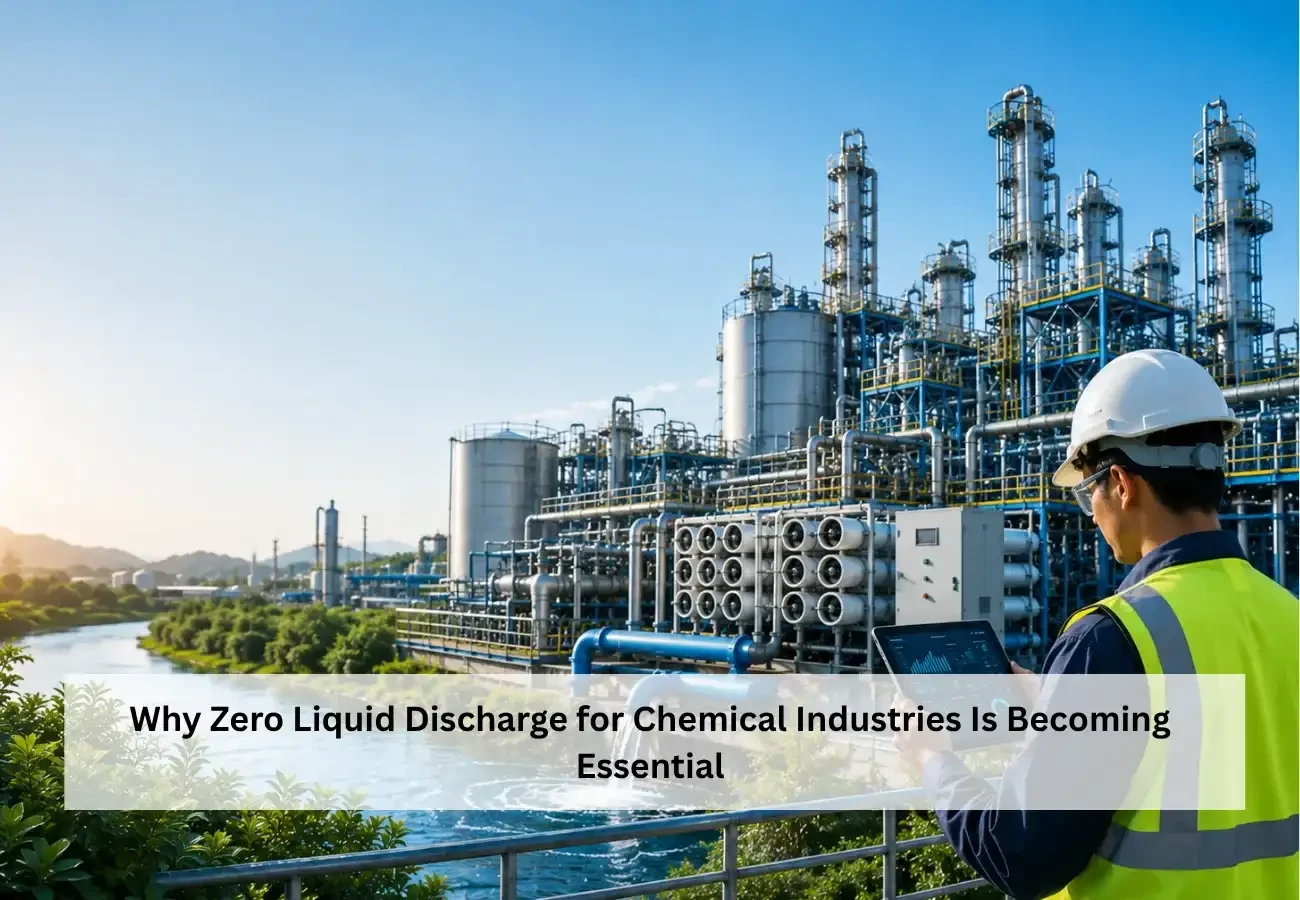

Why Zero Liquid Discharge for Chemical Industries Is Becoming Essential
Chemical plants have always generated wastewater. That part has not changed. What has changed is what they are now expected to do with it. Zero liquid discharge for chemical industries is no longer something plant managers read about at conferences and shelve for later. It is becoming a real, working requirement for facilities trying to stay compliant, stay open, and stay competitive.
Water Problem Chemical Plants Cannot Ignore
Industrial zones in many states sit in some of the country's most water-stressed regions. Groundwater levels in these belts have been dropping for years. Rivers that factories once relied on for both intake and disposal are under far greater scrutiny from regulators and communities alike.
According to India's Central Pollution Control Board, Indian industries generate around 12,000 million litres per day of wastewater, with chemical, textile, and tannery hubs contributing disproportionately to the pollution load.
That volume does not go anywhere clean on its own. And when it ends up in groundwater or nearby rivers, the consequences tend to follow the plant for a long time.
What Zero Liquid Discharge Actually Does
Zero liquid discharge for chemical industries means the plant stops releasing liquid waste altogether. Every litre of water that enters a production process is either recovered and returned to use inside the facility, or evaporated down to a dry solid. Nothing liquid leaves the boundary.
It sounds straightforward, but the process itself involves several treatment stages working together. Raw effluent first goes through pre-treatment to remove suspended solids, oils, and pH imbalances. After that, membrane filtration takes over, with reverse osmosis doing the bulk of the water recovery work. The concentrate left behind after membranes is then passed through evaporators and crystallisers, where the remaining water evaporates off and the contaminants turn into solid material, often recoverable salts.
What comes out at the end is treated water that goes back into the plant and a dry solid that can either be sold or disposed of safely.
Where Water Reuse Fits In
Water reuse inside a chemical facility is one of the more practical outcomes of ZLD. Once water is recovered through the treatment chain, it does not need to meet drinking water standards to be put back to use. Cooling systems, wash cycles, boiler feed, process dilution, and many applications inside a plant work perfectly well with recovered water. That directly reduces how much freshwater the plant needs to draw from outside sources, which matters both for the water bill and for long-term supply security.
Why Chemical Plants Specifically Are Feeling the Pressure
- Regulatory compliance is getting sharper
State Pollution Control Boards in India now mandate ZLD for specific high-pollution industries. Plants implementing ZLD systems ensure environmental compliance while also reducing the risk of operational shutdowns, penalties, and reputational damage.
- The effluent problem is not just regulatory
Chemical manufacturing wastewater is not like domestic sewage. It carries dissolved heavy metals, solvents, acids, salts, and trace compounds that do not break down easily in natural environments. Conventional effluent treatment plants can reduce harm to a degree. But they still release treated liquid. That liquid, even when it meets discharge limits on paper, carries residual load into rivers and aquifers over time.
Effluent management through ZLD removes that ongoing release entirely. There is nothing left to discharge. For plants near ecologically sensitive areas or communities that depend on local water sources, that distinction carries real weight.
The Business Side
- Resource Conservation
One thing that gets underestimated in ZLD conversations is resource conservation through the solid by-products of the process. When brine from reverse osmosis concentrate is evaporated and crystallised, what remains is often recoverable sodium chloride, calcium sulphate, or other mineral salts depending on the feed water chemistry. Some of these can be sold rather than disposed of, which changes the economics of the system meaningfully.
- Reduces Exposure to Water Price Volatility
A plant that recycles 90% to 95% of its water internally is far less exposed to rising municipal water tariffs or groundwater allocation restrictions. Industrial water recycling through ZLD is, in that sense, a hedge. The upfront cost is real. But so is the decade-long protection against an input cost that most forecasts expect to rise.
Wastewater Minimisation as a Longer-Term Strategy
Plants that have adopted ZLD tend to describe a shift in how they think about water inside the facility. Rather than managing wastewater at the end of a process, they begin to manage wastewater minimisation at the start, looking at where water enters, what it carries when it leaves each stage, and where recovery is possible before the water reaches treatment.
That is partly a technology decision and partly an operational one. It often reveals opportunities to reduce water consumption in ways that pay back before the ZLD system itself does.
Industrial Sustainability
Investors, procurement teams at large buyers, and ESG reporting requirements increasingly ask chemical companies about their water management practices. Industrial sustainability as a business credential has moved from optional to expected in many supply chains. A plant that can demonstrate closed-loop water management is in a stronger position than one that cannot, all else being equal.
What We Do at Alantech
At Alantech, our work in total water management spans more than 14 years across industrial clients in India and internationally. Our ZLD systems are not standard configurations. We design around the actual effluent profile of each facility, because a specialty chemicals plant will have very different wastewater characteristics from a pharmaceutical manufacturer in Kerala.
Our solutions integrate pre-treatment, ultrafiltration, reverse osmosis, and thermal stages into a complete system built for how your plant actually operates. We focus on water recovery and water reuse rates that reduce your freshwater dependency in a way that holds up over years, not just on commissioning day.
If your facility is working through compliance timelines, looking at a capacity expansion, or simply asking whether ZLD makes sense for your operating context, get in touch with Alantech.
Frequently Asked Questions (FAQs)
Q1: Which chemical industries in India are required to implement zero liquid discharge?
A1: The CPCB has categorised industries by pollution potential using a colour coding system, and ZLD mandates apply most directly to those in the red category, which includes most chemical manufacturing, pharmaceutical, and petrochemical plants. State Pollution Control Boards can set additional requirements depending on location, particularly in water-stressed zones. If your plant generates significant effluent volumes or operates in a declared critical zone, it is worth checking current compliance status against both central and state-level norms.
Q2: Does a ZLD system completely eliminate the need for freshwater in a chemical plant?
A2: Not entirely, but it comes very close. A properly designed ZLD system typically recovers 90% to 95% of the water passing through it. That recovered water is reused internally, which substantially cuts the volume of fresh water the plant needs to bring in from outside. The small remaining fraction ends up as dry solid waste rather than liquid discharge. So while ZLD does not bring freshwater consumption to absolute zero, it gets close enough that most plants with ZLD in place report a dramatic reduction in external water dependency.