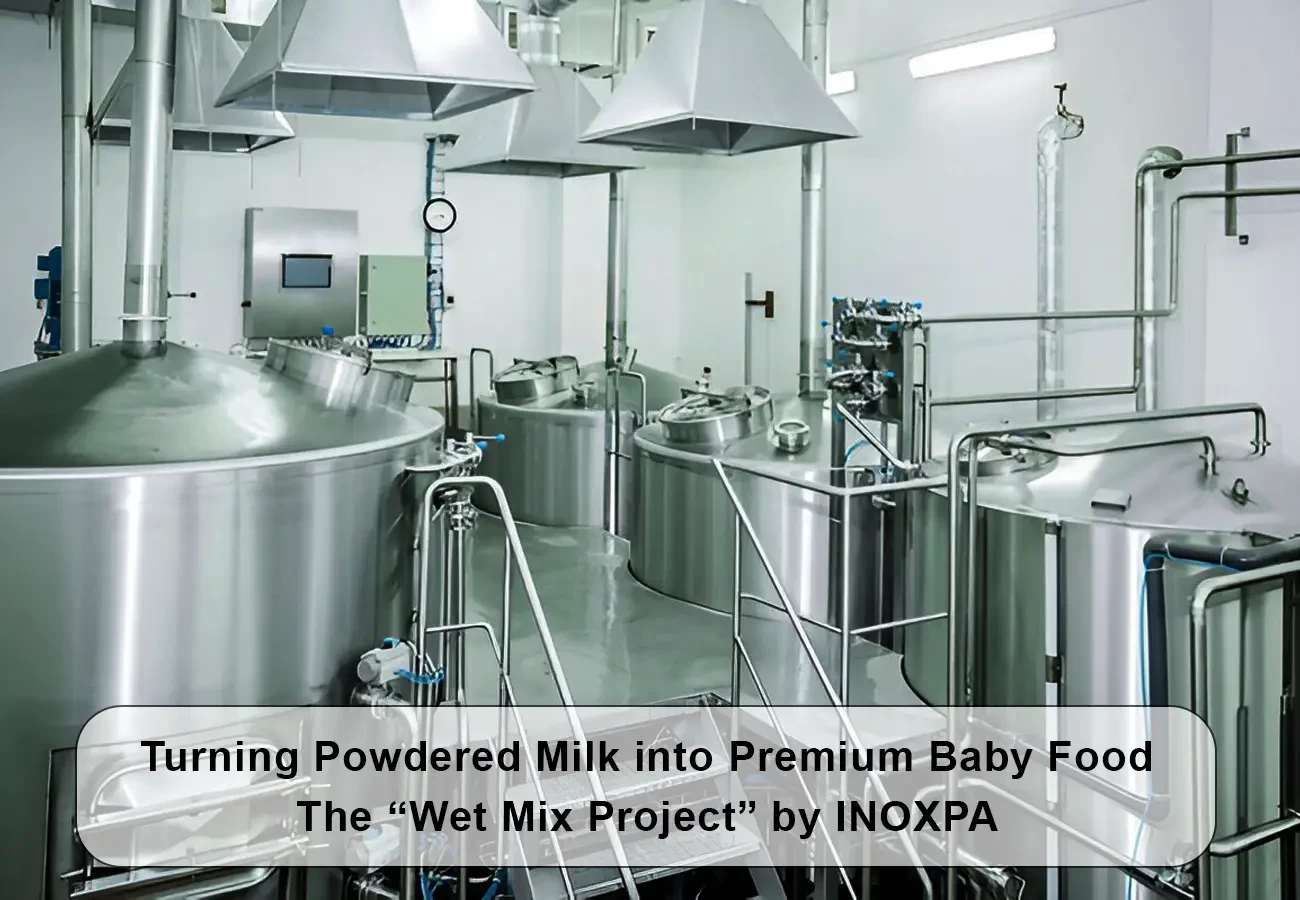

Turning Powdered Milk into Premium Baby Food The "Wet Mix Project" by INOXPA
About the Customer
Raptakos, Brett and Company (RBCL) is a leading baby food manufacturer in India, recognized for delivering safe and high-quality nutrition products for infants. Headquartered in Mumbai, RBCL operates seven manufacturing plants across the country, producing baby food, pharma products, and exporting over 40% of its output. With a strong focus on quality, hygiene, and innovation, RBCL required a state-of-the-art solution to streamline its powdered milk-based baby food production.
The Challenge: Automated Baby Food Production from Powdered Milk
RBCL faced the challenge of creating a fully automated Wet-Mix system that could turn powdered milk into high-quality infant nutrition products. The process required:
- Accurate blending of powdered milk and other ingredients into a uniform wet mix.
- Spray drying the wet mix into consistent infant-safe powdered formulations.
- Handling multiple tanks, approximately 10, connected to a high-capacity powder mixer.
- Managing a complex piping network with precise placement of pumps, filters, valves, and continuous hygiene control.
Initially, RBCL assumed INOXPA could only supply mixing equipment. However, INOXPA’s capabilities extend far beyond this, providing fully integrated turnkey automation solutions, including systems that support industrial processes such as industrial waste water treatment, ensuring operational efficiency and environmental compliance.
The INOXPA Solution: From Mixer to Turnkey System
INOXPA worked closely with RBCL through regular meetings, site visits, and design discussions to develop what became known as the “Wet Mix Project.” The solution package included:
- Custom manufacturing of mixing tanks, pipelines, and CIP (Clean-In-Place) systems designed for infant nutrition safety.
- Integrated automation using Allen-Bradley PLCs with built-in redundancy for high reliability and uptime.
- Installation of centrifugal pumps, high-precision blenders, seat and mix-proof valves, butterfly valves, filters, and agitators. Every component was engineered for hygiene, performance, and long-term operational reliability.
To improve production efficiency and handle materials better, INOXPA included automated conveyor systems. These systems move ingredients smoothly between processing units, reduce the need for manual work, and maintain the high hygiene standards needed for baby food production.
Installation Features & Operational Excellence
- Full Automation & Control:
The Wet Mix system is completely managed using advanced PLC logic, enabling real-time monitoring and consistent operation under strict safety protocols. This automation lowers human error, increases production efficiency, and ensures compliance with food safety regulations.
- CIP Hygienic Integration:
The built-in CIP system enables automatic cleaning between production cycles, reducing downtime and ensuring food safety standards for infant nutrition. It also supports environmental sustainability by lowering water use and waste, aligning with industrial waste water treatment practices at RBCL’s facilities.
- High-Precision Components & Process Efficiency:
Pumps, valves, filters, and mixers were optimized for baby-food quality standards. Additionally, the system accommodates downstream packaging lines, including integration with a bottle filling machine, ensuring the infant formula is safely and efficiently filled into containers with minimal contamination risk.
Why This Project Succeeded
- Collaborative Approach: From concept to installation, INOXPA’s teamwork model ensured the final solution met RBCL’s specific production requirements.
- Proximity and Listening: By staying close to the customer and understanding real production demands, INOXPA delivered a practical and future-ready solution.
- Experience-Driven Insight: Built upon years of designing integrated food-industry projects, the Wet Mix Project exemplifies INOXPA’s expertise in automation, including supporting systems like industrial waste water treatment and material handling.
- Long-Term Trust: The project was delivered on time, to specification, with a fully validated system that satisfied RBCL’s expectations and encouraged plans for wider collaboration.
Key Benefits Realized
- Scalable Automation: The solution allows RBCL to maintain high throughput with minimal manual intervention, supporting multiple plants through integrated automated conveyor systems.
- Hygiene and Regulatory Compliance: The integrated CIP systems and hygienic components help maintain strict infant nutrition safety standards while also supporting environmental practices such as industrial waste water treatment.
- Operational Reliability: Redundant PLC systems, robust engineering, and quality components enhance production reliability.
- Custom Integration Across Plants: The system was designed for RBCL’s multi-plant infrastructure, ensuring seamless operations across different sites.
- Enhanced Packaging Efficiency: Downstream packaging lines, including high-speed bottle filling machines, allow safe and efficient packaging of infant formula, reducing contamination risk and boosting productivity.
- Strategic Partnership Model: The project increased RBCL’s confidence in INOXPA as a trusted partner for complete system integration, rather than just a supplier of individual components.
Conclusion
The “Wet Mix Project” shows how working with an experienced engineering solutions provider like INOXPA can turn basic equipment setups into fully integrated and efficient production systems. By aligning closely with client needs, employing hygienic engineering standards, and offering complete automation, including automated conveyor systems, bottle filling machines, and support for industrial waste water treatment, INOXPA helped RBCL turn powdered milk into safe, consistent, and scalable infant nutrition products.
This partnership improved RBCL’s production efficiency, hygiene, and reliability. It also opened doors for future collaborations, positioning both INOXPA and RBCL as leaders in infant nutrition while upholding high-quality and environmentally responsible practices.
By focusing on automation, hygiene, and efficiency, the Wet Mix Project shows that customized, engineering-led partnerships can improve industrial processes and deliver top-quality infant nutrition products.