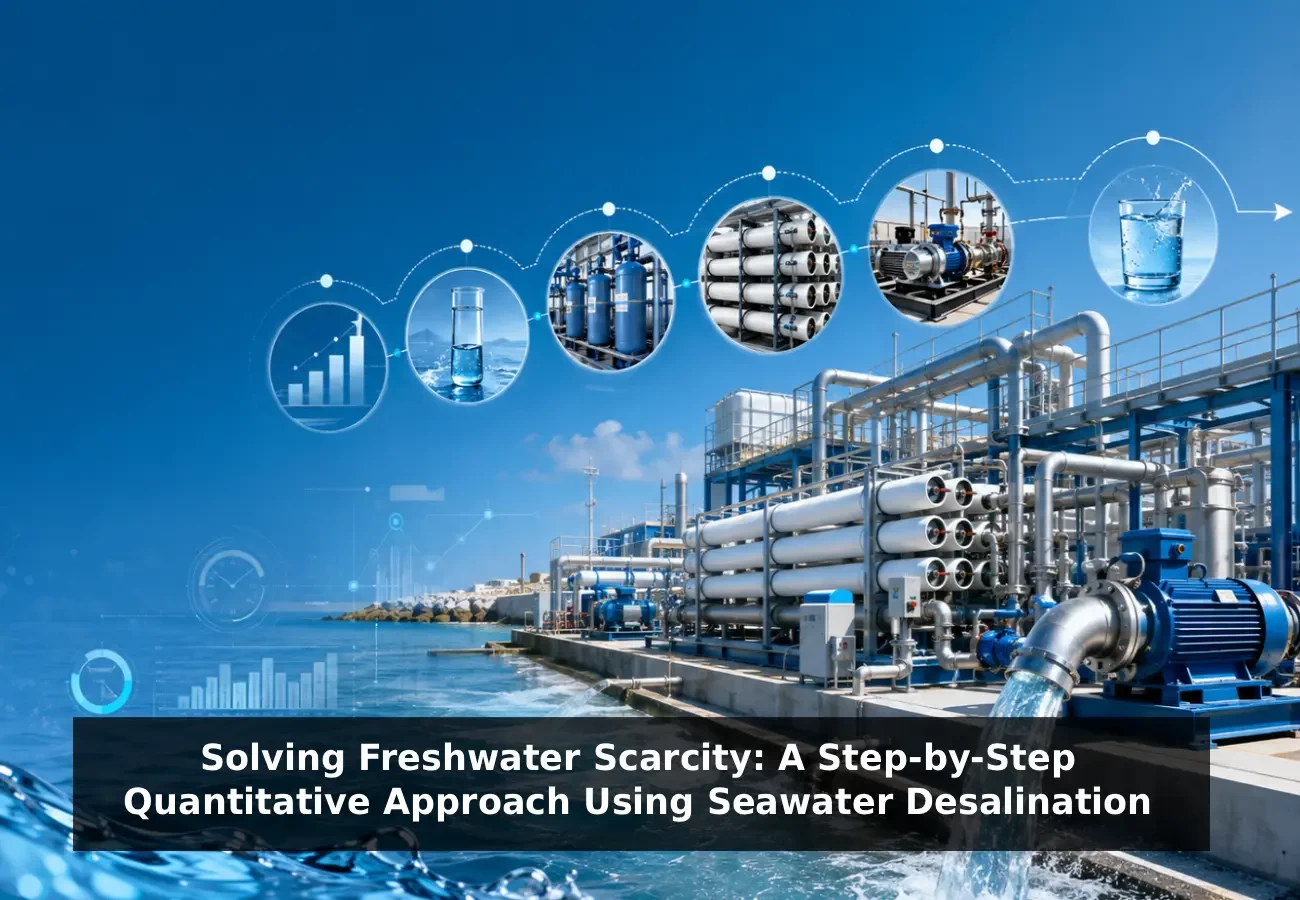

Solving Freshwater Scarcity: A Step-by-Step Quantitative Approach Using Seawater Desalination
Freshwater scarcity is increasingly becoming a concern for industries, municipalities, hotels, power plants and coastal communities across the globe. Growing population, industrial development, falling ground water levels and uncertain climate conditions are putting great pressure on available fresh water resources. Seawater desalination has emerged as a reliable and sustainable solution to provide continuous water availability for many coastal-based industries.
Seawater desalination is a process that uses advanced treatment technologies to convert seawater into usable freshwater, helping industries reduce their dependence on natural freshwater sources and supporting long-term sustainability goals.
At Alantech, we provide energy-efficient and conscious seawater desalination systems to meet the water needs of today’s industries.
Understanding the Problem of Water Scarcity
Water is a challenge to operate many industries. Fresh water is limited.
Typical challenges are:
- Depletion of groundwater
- Rising cost of getting water
- Ingress of salinity in bore wells
- Seasonal droughts and low rainfall
- Increasing industrial water demand
- Environmental constraints on freshwater abstraction
Industries may suffer production delays, lower productivity and increased costs from the absence of a reliable water supply.
The dependable alternative to seawater desalination is the abundance of seawater to create a steady flow of fresh water.
Step 1: Quantitative Water Use Evaluation
The initial stage in the design of a desalination plant is to properly determine the water demand. The assessment includes:
- Water use per day
- Maximum operating demand
- Water quality needed
- Recovery objectives
- Future growth plans
For example, the industrial facility needs to determine the present and future water needs before the system design begins, for example 500 m3/day of freshwater.
A detailed quantitative study can be used to assist in optimizing plant capacity, energy use and operating efficiency without oversizing or underperformance.
Step 2: Analysis of Raw Seawater Quality
High concentrations of dissolved salts, suspended solids, microorganisms and scaling compounds in seawater can influence system performance.
Typical seawater salinity is in the range of:
- 35000 to 45000 mg/L
Complete water analysis helps to identify:
- pre-treatment standards
- Choice of membrane
- Requirements for chemical dosing
- Scaling and potential for fouling
Alantech’s thorough seawater analysis ensures that every desalination system is designed for maximum reliability and long membrane life.
Step 3: Pre-treatment to protect the system
pre-treatment is one of the most important steps in seawater desalination to prevent fouling and damage to the RO membranes.
Typical pre-treatment processes are:
- Screening at entry
- Multimedia filtering
- Activated carbon filters
- Ultrafiltration System
- Antiscalant and chemical dosing.
Effective pre-treatment reduces contaminants before the water enters the RO membranes and improves the overall system performance.
Advantages include:
- Less membrane fouling
- Better recovery efficiency
- Reduced maintenance costs
- Extended membrane life
- Dependable plant operation
A well-designed pre-treatment system greatly enhances the reliability of a desalination plant.
Step 4: Desalination by reverse osmosis
The core technology of modern seawater desalination plants is Reverse Osmosis (RO).
The process uses high pressure pumps to push seawater through a semi-permeable membrane that separates the salts and other impurities from the water.
Typical seawater RO operating pressure:
55 - 80 bar
Average recovery rate:
35-50 per cent
For example, if a plant treats:
1000 m3/day
at a ratio of 1:1.
45%
the freshwater flux is then:
450m3/day,
This step-by-step quantitative approach makes the water production planning by industries accurate and efficient
Step 5: Energy Efficiency & Sustainability
There are numerous ways in which energy is consumed in seawater desalination processes. However, with new advancements, modern-day desalination plants have adopted technologies that optimize the use of energy to minimize operating costs.
Some of the most notable include:
- Energy recovery devices (ERDs)
- Highly efficient pumps
- Variable frequency drives (VFDs)
- Monitoring
In Alantech, our emphasis on energy efficiency lies in optimizing system integration for sustainable seawater desalination processes.
Step 6: Post-Desalination Treatment & Distribution
The process of post-desalination involves the balancing of minerals in the treated water, the balancing of its pH level, ultraviolet treatment, and chlorine treatment.
This ensures the treated water meets industrial or potable water quality standards before distribution.
Why Choose Alantech?
At Alantech, we offer bespoke seawater desalination systems that cater to your industrial needs. From system design to installation, automation, and after-sales support services, we ensure that our customers get efficient and energy-saving water treatment plants designed for lasting usage.
Contact Alantech
Do you need a seawater desalination system to cater to your industrial needs? Reach out to Alantech for a customized water treatment plant for your business.