
Single-Vendor Solution for Filtration, RO & Wastewater Reuse: A Smarter Path for Industrial Water Management
In any industrial environment, water is more than just a utility, it forms the foundation that keeps production activities stable, safe, and efficient. From the first step of filtration to the functioning of a reverse osmosis plant and eventually to the stage of wastewater reuse, each part of the treatment cycle needs to operate in a smooth sequence. When all these systems are designed to support one another, industries gain steady water quality, lower operational risks, and stronger long-term sustainability.
However, this smooth flow becomes difficult when the entire treatment cycle is executed by multiple vendors. Each supplier often brings a different design philosophy, installation method, automation logic, and service framework. The result is a system that looks complete on paper but fails to operate as one unit.
The Problem: "Multiple Vendors, Multiple Headaches."
Many industries today rely on separate suppliers for their filtration systems, ultrafiltration plant, reverse osmosis plant, and wastewater reuse units. Individually, these vendors may offer capable solutions, but when their systems are combined, several gaps begin to appear. Instead of an integrated waste water treatment plant, companies end up dealing with broken communication, mismatched performance, and unpredictable output.
One of the biggest problems that arises in multi-vendor environments is inconsistent system design. Since each vendor focuses solely on their product, critical aspects such as flow rates, pressure requirements, membrane compatibility, and feedwater parameters are often overlooked. A filtration system that sends unstable feed quality can severely affect the performance of an ultrafiltration plant, which in turn impacts the recovery and permeate quality of the reverse osmosis plant. These issues eventually influence the efficiency of the overall industrial wastewater treatment process.
Maintenance also becomes complicated. Different vendors follow different service intervals, use different types of spares, and set different standards for troubleshooting. This leads to confusion, extended downtime, and frequent disruptions in water availability. With responsibilities divided across multiple parties, no vendor takes ownership of the entire treatment chain. When something goes wrong, industries often find themselves trapped in a blame cycle.
This fragmented approach results in:
- More downtime
- Rising operational costs
- Poor membrane life
- Compromised water quality
- Lower system reliability across the treatment cycle
Ultimately, productivity suffers, and so does profitability, because water is at the core of most industrial operations.
Why This Happens: "Systems Built in Silos Can't Work in Harmony."
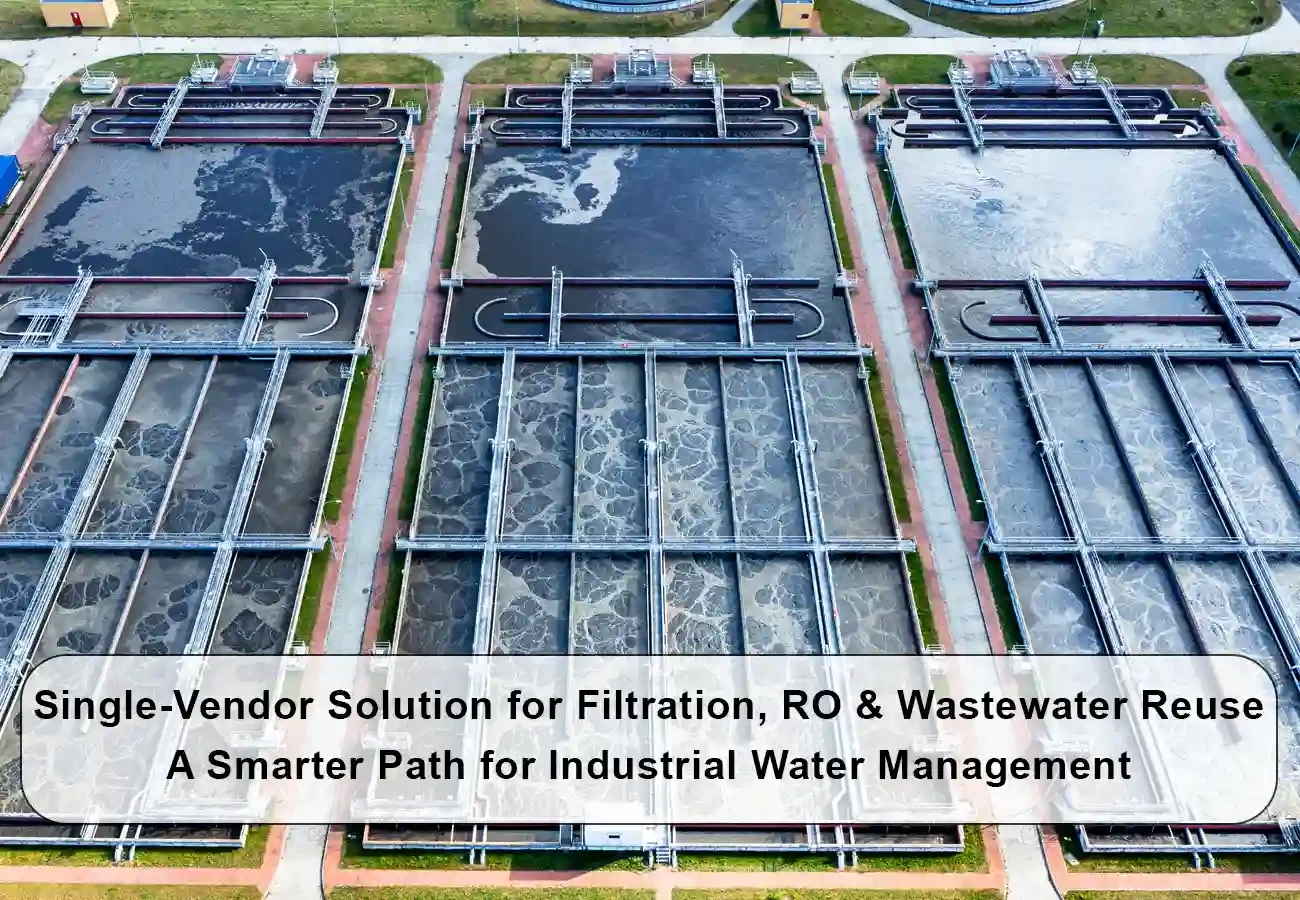
A successful waste water treatment plant is not an assortment of equipment; it is a carefully balanced ecosystem. When each part of the system, filtration, UF, RO, and reuse, is purchased from a different vendor, the entire chain becomes vulnerable.
Each vendor typically designs their system in isolation, without fully understanding what comes before or after their part of the process. Engineering approaches vary widely across suppliers. One vendor may prioritize high pressure; another may aim for lower flow; some may include advanced automation, while others use basic controllers.
In a setup involving an ultrafiltration plant, precision is crucial. UF units require stable flow and consistent feedwater quality. Without this stability, membrane fouling increases, operational cycles shorten, and chemical cleaning frequencies rise. When an upstream system supplied by a different vendor is not aligned with the UF requirements, the downstream reverse osmosis plant also suffers due to poor pretreatment.
Differences in sensor calibration, PLC programming, and control logic further complicate coordination. Multi-vendor setups may use different automation platforms that do not communicate effectively. Industries, as a result, face challenges in monitoring important KPIs such as recovery percentages, permeate quality, membrane pressure, energy consumption, and waste generation.
Over time, these misalignments create wider operational gaps. Inconsistent performance from the industrial wastewater treatment section affects fresh water requirements, increases the load on ETP or reuse stages, and raises overall water consumption. As the system becomes more difficult to manage, industries spend more on corrective maintenance instead of preventive action.
The core issue is simple: when the treatment chain is divided, accountability disappears. No vendor is responsible for guaranteeing end-to-end water quality or the long-term performance of the entire cycle. This is why systems built in silos cannot achieve true harmony.
Alantech’s Solution: "One Expert, One System, One Seamless Experience."
Alantech eliminates fragmentation entirely by delivering a unified, single-vendor solution that integrates filtration, the ultrafiltration plant, the reverse osmosis plant, and the complete waste water treatment plant into one seamless ecosystem. Instead of dealing with multiple suppliers, industries work with one expert partner who manages design, engineering, installation, automation, and service.
Every component in an Alantech-designed system is matched to the next. Flow rates are harmonized. Pressure levels are balanced. Membrane compatibility is ensured. Pre-treatment is optimized to support UF units, and UF output is stabilized to enhance RO life and performance. The result is a more reliable and efficient water treatment cycle.
Automation also becomes unified. Instead of dealing with several control systems, industries receive one integrated PLC platform that monitors all stages of operation, from filtration to RO to the industrial wastewater treatment section. With centralized data, operators gain full visibility into KPIs, making it easier to maintain consistency, troubleshoot quickly, and plan preventive maintenance.
Another major advantage is the dedicated service framework. A single, experienced team handles preventive maintenance, chemical cleaning cycles, membrane replacements, spares, and troubleshooting. This eliminates delays caused by vendor coordination and ensures continuous, uninterrupted operation.
Industries using Alantech’s integrated approach experience:
- Predictable permeate quality
- Increased water recovery
- Extended membrane life
- Reduced chemical usage
- Lower energy consumption
- Higher uptime
- Improved long-term sustainability
Whether it is a filtration unit or a large-scale waste water treatment plant, Alantech ensures that every part of the system supports the next. Through a single vendor approach, industries are able to maintain tighter operational control, achieve higher levels of efficiency, and rely on one accountable partner for the entire system. These benefits are rarely seen in multi vendor arrangements.
Conclusion
Water management in industrial environments demands precision, reliability, and long-term sustainability. Multi vendor systems often fail due to poor compatibility and unclear accountability. A single vendor approach creates a more stable and efficient treatment chain that connects filtration, UF, RO, and industrial wastewater treatment.
With Alantech as the partner, companies gain a smooth, end to end water treatment ecosystem that runs with less effort and delivers stronger value across daily operations. It is a smarter, more dependable path for industries that rely heavily on water for daily operations.