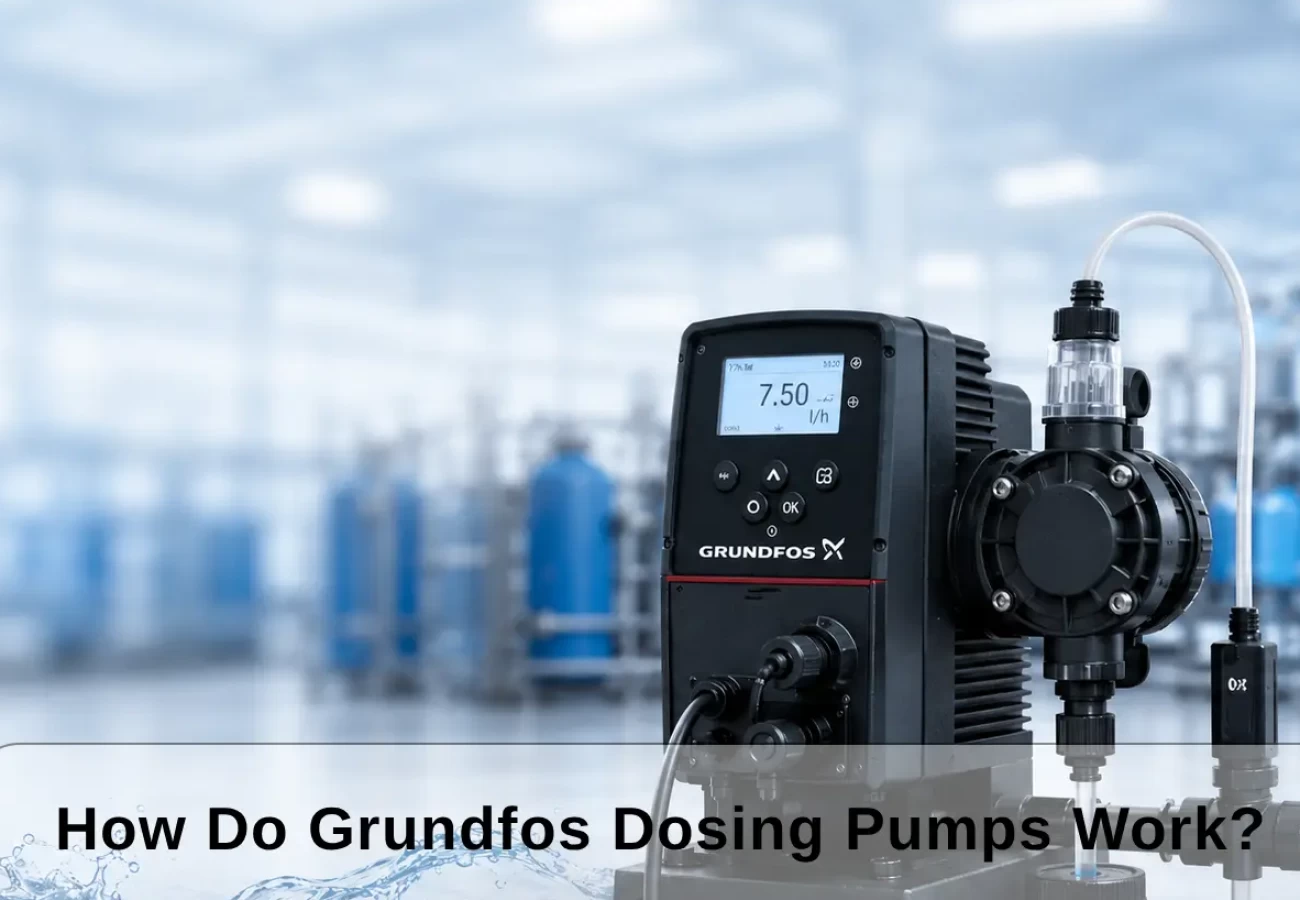

How Do Grundfos Dosing Pumps Work?
Grundfos dosing pumps work by drawing chemical from a supply tank and pushing it out in small, measured amounts, either through a diaphragm driven by a motor or, in newer digital models, a stepper motor controlled electronically. The pump repeats this stroke at a set rate, and digital versions can adjust that rate automatically based on sensor feedback from the process.
Key Takeaways
- Grundfos dosing pumps mainly use diaphragm technology to move chemicals without the fluid touching moving parts.
- Digital models use stepper motors, which allow far finer control over dosing volume than older mechanical designs.
- Some ranges include built-in flow measurement, so the pump can confirm each dose actually happened.
- Setup and monitoring on newer models can be done through a mobile app rather than manual dials.
- Choosing the right Grundfos dosing system depends on chemical type, required accuracy and how the process is monitored.
The Grundfos Dosing Pump Working Principle
A Grundfos chemical dosing pump uses a diaphragm that flexes back and forth inside a dosing head. On the intake stroke, the diaphragm pulls back, drawing chemicals in through a check valve. On the discharge stroke, it pushes forward, forcing that same measured volume out through a second valve into the process line. Because the diaphragm separates the chemical from the pump's mechanical parts, there is no direct contact between moving components and often-aggressive fluids, which keeps wear down and reduces the risk of leaks.
This is broadly how mechanical dosing has worked for years across the industry, not just for Grundfos. What sets the Grundfos dosing pump working principle apart in more recent models is the addition of a stepper motor rather than a simple on/off solenoid. A stepper motor can move in tiny, precise increments, so the pump isn't limited to a handful of fixed stroke settings. It can dial dosing volume up or down across a wide range without swapping parts.
Mechanical Dosing vs Digital Dosing
Mechanical dosing pumps typically control output by adjusting the stroke length, stroke frequency or both. They are effective for steady dosing applications but generally offer less flexibility and control than modern digital dosing systems. It does the job, but it doesn't adapt on its own if conditions change partway through a dosing cycle.
Digital dosing, which is where a fair bit of Grundfos's more recent product development has gone, allows the pump to vary its output continuously rather than in fixed jumps. Some models pair this with a built-in flow sensor that measures the volume of each dose as it happens, rather than assuming the stroke delivered what it was meant to. That measurement can then feed back into the pump's control logic, which helps catch problems like air locks or blocked valves before they become bigger issues.
Mechanical vs Digital Grundfos Dosing
Key Components in a Grundfos Dosing System
A complete Grundfos dosing system usually includes more than just the pump itself.
- Dosing head and diaphragm - where the actual pumping action happens.
- Check valves - control the direction of flow on intake and discharge strokes.
- Suction and discharge lines - carry chemical to and from the process.
- Control unit - either basic manual dials or, on digital models, a display and connectivity options.
- Optional flow sensor - confirms each dose on select digital pumps.
Setup and Monitoring
On supported SMART Digital models, parameters can be configured and monitored through compatible Grundfos connectivity and control tools, including the Grundfos GO app where available. This doesn't change how the pump physically doses chemical, but it does make it quicker to alter settings or check status without opening the unit up. Some models also support connection to wider control systems like SCADA, which is useful in larger industrial or municipal sites where several pumps need coordinating.
Where Grundfos Metering Pumps Are Used
A Grundfos metering pump shows up in quite a few different settings, largely because chemical dosing is needed anywhere water quality or process consistency has to be maintained.
- Municipal drinking water and wastewater treatment plants
- Industrial process water systems
- Cooling towers, where scale and bacterial growth need managing
- Food and beverage production, including breweries and bottling lines
- Agricultural fertigation and chemigation systems
In each of these, the underlying goal is the same, and it delivers the right amount of chemical, consistently, without over- or under-dosing.
Conclusion
A Grundfos dosing pump works on the same basic principle as most chemical dosing equipment: it moves a measured amount of chemical, one stroke at a time, into a process line. What separates the mechanical and digital ranges is mostly about control and feedback, with digital models offering finer adjustment, wider dosing ranges and, on some units, built-in dose verification through a flow sensor. Which one suits a given site depends on how much precision the process actually needs and whether remote monitoring is a priority.
Get in touch with Alantech, and we can help you choose the right dosing pump setup for your process.
Frequently Asked Questions (FAQs)
Q1: What type of pump mechanism do most Grundfos dosing pumps use?
A1: Most Grundfos dosing pumps use a diaphragm mechanism, which keeps the chemical separated from moving parts and reduces wear over time.
Q2: How is a Grundfos digital dosing pump different from a mechanical one?
A2: A digital pump uses a stepper motor for finer, adjustable control and, on some models, includes a built-in sensor to confirm each dose, while a mechanical pump delivers a fixed volume each cycle without that feedback.
Q3: Can Grundfos dosing pumps be monitored remotely?
A3: Yes, several models in the SMART Digital range support app-based setup and can connect to wider monitoring systems for remote oversight.
Q4: Are Grundfos dosing pumps suitable for small-scale applications?
A4: Yes, Grundfos offers a range of pump sizes, and smaller mechanical or digital models are commonly used in applications like small commercial water treatment or cooling systems, not just large industrial plants.