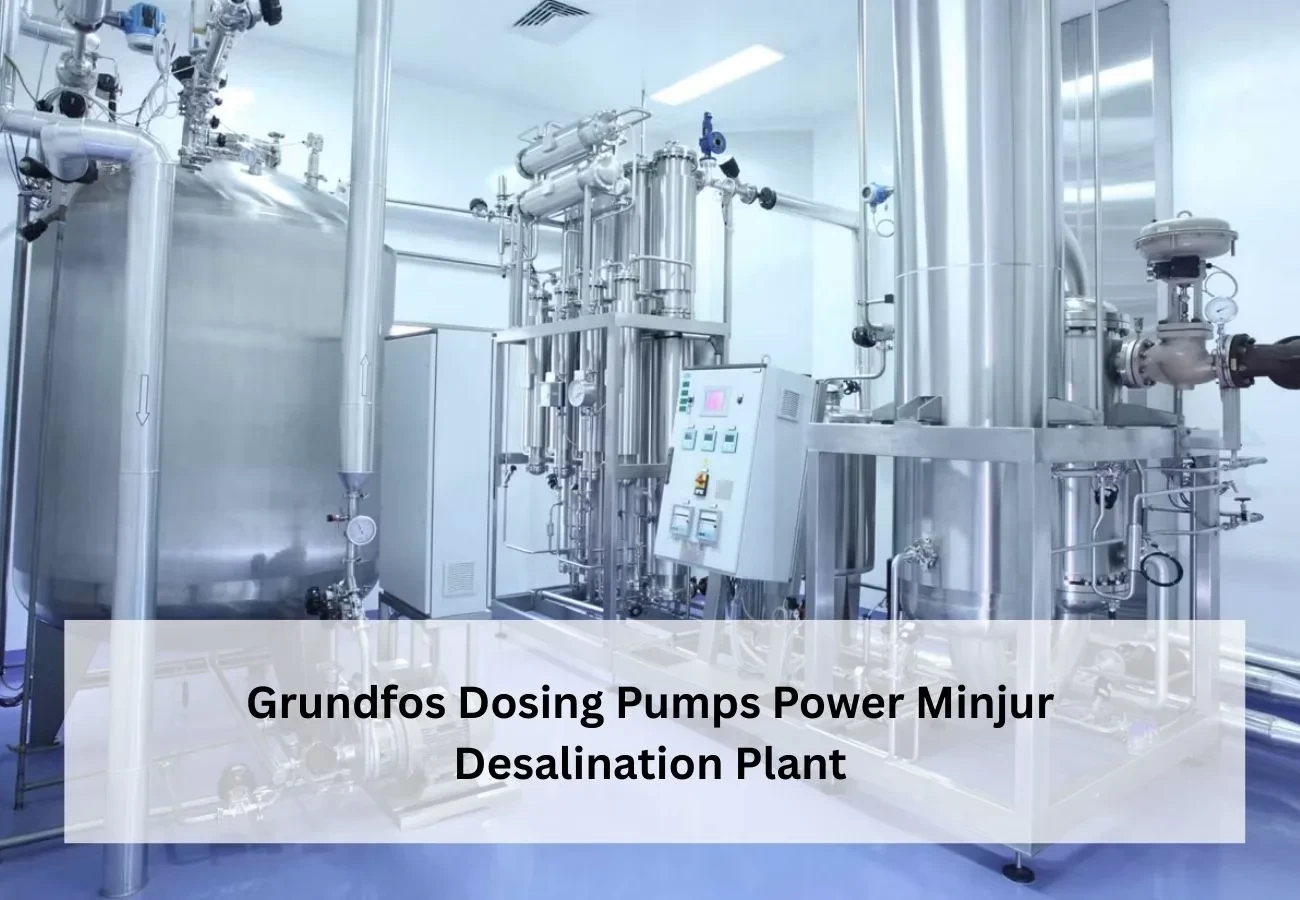

Minjur Desalination Plant: How Grundfos Dosing Pumps Support Chennai's Water Security
In Minjur, a coastal town in the Thiruvallur district near Chennai, a major water infrastructure project is transforming the area’s drinking water supply. A large-scale seawater desalination facility is being developed to give 100 million litres of potable water every day, creating a reliable and sustainable water source for Chennai’s growing population.
At the heart of this transformation is the role of Grundfos dosing pumps, which ensure accurate and consistent chemical treatment across every stage of the desalination process. Precision dosing plays a very important role in maintaining water quality, protecting membranes, and supporting operational efficiency.
This project supports Chennai’s long-term water security and demonstrates how advanced engineering and proven pump technology can strengthen India’s water infrastructure landscape.
Project Background: Addressing Chennai’s Water Challenge
Ongoing urban development, population pressure, unpredictable rainfall, and limited freshwater availability have made water security a main issue for Chennai. Traditional surface and groundwater systems are no longer sufficient. To bridge this gap, Chennai Metro-Water partnered with Befesa Construction y Tecnología Ambiental of Spain to implement one of the largest desalination facilities in the region.
Spread across nearly 60 acres, the Minjur plant draws seawater from about 10 metres below sea level, processes it through multiple advanced treatment stages, and distributes safe drinking water throughout the city network. The system is designed to intake more than 230 million litres of seawater per day, converting it into 100 million litres of potable water using a highly efficient reverse osmosis plant configuration.
From an engineering standpoint, the facility also qualifies as a large-scale MLD water treatment project, capable of supporting Chennai’s long-term urban water demand while reducing dependency on monsoons and reservoirs.
Understanding the Desalination and RO Process
The Minjur desalination facility uses a structured three-stage treatment process to convert seawater into drinking water.
- Pre-Treatment
The pre-treatment process begins with filtration and chemical conditioning of incoming seawater. By reducing suspended solids, organic matter, and biological contaminants, this step helps protect the downstream membranes. Controlled chemical dosing ensures scaling, fouling, and corrosion risks remain under control.
- Reverse Osmosis (RO)
The conditioned water passes through high-pressure membranes where dissolved salts and impurities are separated. This stage forms the core of the system and operates as a highly efficient RO water treatment plant, producing low-salinity permeate suitable for consumption.
- Post-Treatment
After desalination, the water is stabilised and mineralised. pH adjustment and disinfectant dosing ensure the water meets potable quality guidelines before being released into the municipal distribution network.
Accurate chemical dosing is necessary during both pre- and post-treatment stages. Any deviation can impact membrane life, system efficiency, and final water quality. This is where Grundfos technology delivers measurable performance advantages.
Also Read: Understanding pH Levels in Water Why It Matters for Health and the Environment
Customised Grundfos Solution for the Minjur Plant
For pre- and post-treatment dosing, Befesa needed better systems that could integrate seamlessly into the desalination process while maintaining reliability in a demanding coastal environment. The solution from Grundfos centred on application engineering, digital dosing pumps, and modular skid assemblies supported by local service teams. For the Minjur plant, 28 Grundfos DME digital dosing pumps were supplied and arranged on customised skids for seamless operation.
The package included:
- DME 940-4 AR-PV/V/G-S-31A2A2F – 10 units
- DME 375-10 AR-PP/E/G-S-31A2A2F – 9 units
- DME 60-10 AR-PP/E/C-S-31QQF – 3 units
- DME 81-10 AR-PP/E/G-S-3111F – 3 units
- DME 150-4 AR-PV/T/C-S-31QQF – 3 units
Each dosing skid had three or four pumps, depending on application demand. The skids also came with pulsation dampeners, flow meters, isolation valves, and counter-pressure valves for stable dosing even under variable flow conditions.
By working closely with the project engineers, Grundfos ensured that the dosing systems integrated seamlessly with the plant’s hydraulic and control architecture.
Why Digital Dosing Matters in Desalination
Desalination environments demand extremely high dosing accuracy due to fluctuating seawater quality and pressure conditions. Grundfos DME pumps provide digital diaphragm technology that gives consistent chemical injection regardless of pressure variations.
Some of the key performance advantages include:
- High Dosing Accuracy – Digital control promises better chemical delivery even when flow rates vary.
- Turnkey Integration – Skid-mounted solutions fit directly into the desalination layout without immense rework.
- Operational Reliability – Designed for continuous duty in large-scale water treatment installations.
- Reduced Chemical Waste – Accurate metering prevents over-dosing and chemical losses.
- Local Support – Service engineers ensure long-term performance and preventive maintenance.
Such reliability is critical in infrastructure-level projects where downtime directly impacts public water supply.
Role of Grundfos as a Technology Partner
Beyond supplying pumps, Grundfos played the role of a technical partner throughout the project lifecycle. From design consultation to commissioning and service planning, the company ensured that every dosing element aligned with the plant’s operational goals.
As trusted Grundfos Pumps Suppliers, the company supported the project with:
- Application engineering expertise
- Custom skid design
- On-site commissioning assistance
- Long-term service availability through Grundfos India
This partnership approach made Minjur desalination facility operate efficiently with minimal risk of dosing failure or membrane damage.
Supporting Chennai’s Long-Term Water Security
With Chennai’s expanding urban footprint, large-capacity systems like Minjur are essential for future resilience. Classified as a major MLD water treatment installation, the plant plays a strategic role in supplying stable drinking water regardless of seasonal variability.
With advanced RO membranes and accurate dosing systems, the plant functions as a state-of-the-art RO water treatment plant, reliably delivering safe and high-quality potable water to the city’s population.
The desalination infrastructure also sets a benchmark for other coastal cities exploring seawater conversion as a dependable water source.
Conclusion: A Model for Future Water Infrastructure
This project shows the power of using innovative engineering, precise digital dosing systems, and trusted service partnerships to overcome critical urban water issues.
With support from experienced Grundfos Pumps Suppliers, the Minjur facility stands as a scalable model for future desalination and large-capacity water treatment initiatives across India and beyond.