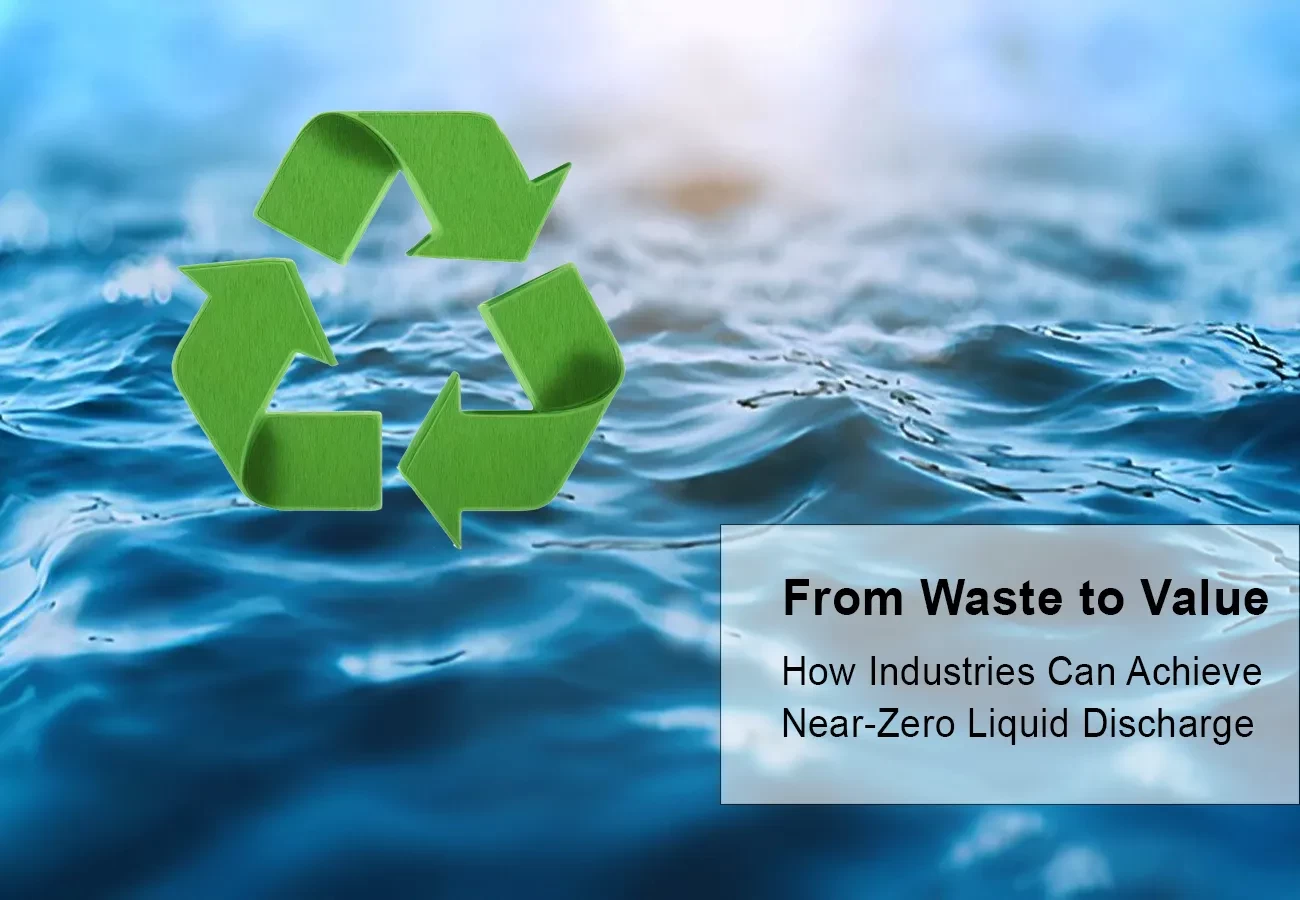

From Waste to Value: How Industries Can Achieve Near-Zero Liquid Discharge
Industrial wastewater doesn’t have to be waste or a burden anymore, it should be treated, recycled, and reused in possible ways. For decades, industries around the world have viewed wastewater only as an unavoidable by-product of production. It was something to treat just enough to meet regulations before discharging it into rivers, lakes, or municipal systems. But nowadays, a lot has changed in the recycling of wastewater. With rising environmental concerns, stricter government rules, and the urgent need to protect water resources, businesses are rethinking how they handle wastewater. Today, the focus is on turning waste into value, and one of the most promising solutions is achieving near-zero liquid discharge (ZLD).
This approach lies in the recycling of wastewater and helps industries comply with laws. By recycling water within their own facilities, industries can cut down on costs and reduce their freshwater demand, as well as minimize environmental harm.
Why Industries Need to Rethink Wastewater
Water scarcity is becoming one of the most pressing challenges worldwide. As populations grow and urban areas expand, industries are under increasing pressure to reduce their dependence on freshwater sources. Manufacturing, textiles, power generation, pharmaceuticals, food processing, and chemical plants are all water-intensive sectors that consume massive amounts of this limited resource.
The reality is that industries can no longer afford to waste water. By adopting the recycling of wastewater, they reduce their footprint and secure a reliable supply of water for their future operations. More importantly, they show responsibility toward the environment and the communities around them.
What Is Near-Zero Liquid Discharge (ZLD)?
Near-zero liquid discharge is a process where industries treat wastewater to a point where almost no liquid is released into the environment. This is done by purifying, recycling, and reusing water within the plant, and by separating solid waste and salts and disposing of or repurposing them safely.
Through this approach, harmful pollutants are prevented from entering rivers and groundwater, thus protecting ecosystems and communities from the contamination caused by these pollutants. Meanwhile, the treated water is also a valuable resource for the industry in that it can be used for cooling, cleaning, and even production at the same time.
How Recycling of Wastewater Works in Industries
The recycling of wastewater involves several stages of treatment that clean the water step-by-step. While each industry may need a slightly different setup, the process usually follows this flow:
- Pre-Treatment Stage
As part of the pre-treatment stage, large particles, oils, and suspended solids are removed from the water so it can be treated further.
- Primary Treatment
A primary treatment involves a chemical or biological process that breaks down organic matter and reduces the amount of pollutants.
- Secondary Treatment
A secondary treatment is performed by using techniques such as membranes or advanced filtration to remove dissolved salts, heavy metals, and other contaminants from the water.
A combination of evaporation and crystallization is used to concentrate and recover water while isolating solid residues.
In these stages, industries are able to recover 95-99 percent of their wastewater, allowing them to recycle it within their facility and reuse it. There is, however, a much smaller amount of solid waste that can often be repurposed in other sectors in order to reduce the amount of solid waste.
Benefits of Recycling Wastewater
It might seem like a major investment to switch to a near-zero liquid discharge system, however, the long-term benefits are more. Here are some of the key benefits:
- Reduced freshwater dependency
The demand for freshwater from industries often competes with the supply from cities and agriculture. As a result of recycling wastewater, companies are able to greatly reduce the amount of external water they need, and this ease the pressure on local supplies of water.
- Lower costs in the long run
The setup may appear to be expensive, however businesses will save money in the long run by not having to purchase water, reducing the cost of wastewater disposal, and reusing valuable by-products from effluents.
- Regulatory compliance
With strict rules, it is becoming more and more difficult to comply with environmental regulations every year. ZLD has been able to develop compliance solutions that prevent industries from being fined and shut down because of noncompliance.
- Environmental protection
It is important to recycle wastewater in order to prevent harmful pollutants from reaching rivers and lakes. A true eco-friendly business model provides the advantage of preserving aquatic life, preserving biodiversity, and reducing the company's overall environmental impact.
- Improve the sustainability image
There is an increasing expectation among customers, investors, and communities that businesses act responsibly. When companies adopt sustainable water practices, they gain trust, improve their brand reputation, and stand out as leaders in their industry.
Challenges in Adopting ZLD
Despite its advantages, achieving near-zero liquid discharge comes with its own set of challenges. There is a high capital investment required for the technology, as well as skilled operation and continuous maintenance. The energy costs that are associated with processes like evaporation may also be high in some cases.
However, as technology advances and more companies adopt the recycling of wastewater, costs are steadily decreasing. Many industries are now finding that water and compliance savings far outweigh the initial expense.
Furthermore, governments are also providing incentives and support to businesses in order to increase their commitment to implementing sustainable business practices.
Real-World Applications of ZLD
When it comes to ZLD, industries across the globe are already making the switch. Textile plants in India recycle coloured wastewater back into their operations, and this reduces their freshwater usage to a great extent. By reusing wastewater for cooling, power plants are reducing their environmental footprint as well as their energy consumption. A near-zero liquid discharge system can contribute to the reduction of pollution as well as ensure water is available for the production process, even in chemical and pharmaceutical manufacturing facilities.
As a result of this real-world application of wastewater, it is evident that wastewater can be utilized for many purposes beyond the management of waste. In the long run, this can prove to be an important resource for industries as long as they are willing to invest in the right systems and processes.
The Future of Wastewater Management
As you might know, the global water demand for water is on the rise, and industries have a great role in ensuring the sustainability of this valuable resource. The recycling of wastewater and the adoption of zero-liquid discharge are not just compliance measures, they also provide a pathway towards a sustainable future. In order for industries to move toward circular water use, they must stop seeing wastewater as a problem and start treating it as an opportunity instead.
In the near future, we will probably see more automation, smarter monitoring, and more energy-efficient systems that will make ZLD affordable for even smaller industries in the future. We need to start recycling water today, because every step we take toward recycling water today helps to protect the resources of tomorrow.
Conclusion
Wastewater generated by industrial processes should no longer be perceived as a problem. Industry can turn waste into value with modern solutions such as advanced wastewater treatment plants and near-zero liquid discharge. In addition, these methods help companies cut costs, protect the environment, and build a stronger foundation for their future operations using these methods.
If your company is looking for sustainability and smarter water recycling or treatment, Alantech can help. With expertise in advanced wastewater treatment and proven solutions customized to different sectors, Alantech offers efficient and advanced water treatment plants.