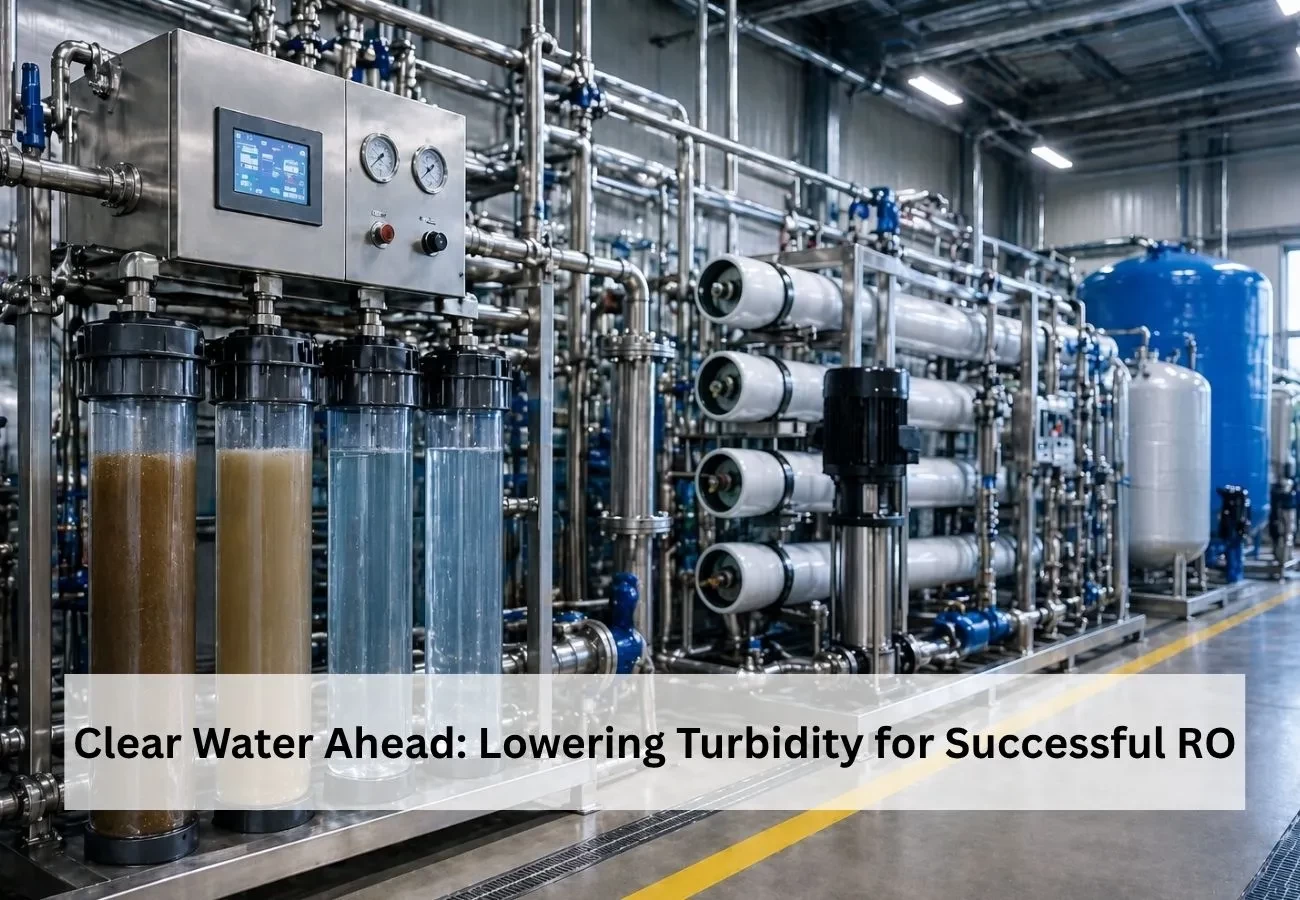

Clear Water Ahead: Lowering Turbidity for Successful RO
Reverse Osmosis plant systems are very vulnerable to the quality of their feedwater input. Turbidity, or the amount of suspended solids in water such as silt, clay, and biological components, is perhaps the most crucial variable when it comes to RO's efficiency in any reverse osmosis system.
Turbidity in surface water supply can be significantly increased during monsoons and rainy seasons. An increase in the amount of turbidity will elevate the Silt Density Index of feedwater if not appropriately treated, and this can have an adverse effect on the efficiency of the RO system. A properly designed raw water plant will go a long way in addressing this issue.
The Reasons Turbidity Affects RO Systems
An increase in the presence of suspended solids in the feed water of the treatment system is characterized by increased turbidity. The fouling of the RO membranes occurs due to accumulation of the particles on the membrane surface.
As per the Alantech SDI guide, the higher levels of SDI could result in:
- Reduced permeate flow rates
- Higher pressures between the membranes
- Increased energy consumption
- Increased energy consumption
- Shortened membrane life span
In simple terms, an RO plant with high SDI operates with low efficiency and high operational cost.
Also Read: Turbidity Treatment: Eliminating Uncertainty with Automation
What SDI Is and Why It's Important
The tendency of water to foul is assessed using the Silt Density Index (SDI), which indicates how fast the suspended particles are capable of fouling a standard membrane filter.
In most RO applications, SDI:
- SDI < 3: Good feed water quality
- SDI 3–5: Adequate but could raise the risk of fouling
- SDI > 5: Fouling tendency high; feed pre-treatment required
To ensure RO stability and membrane longevity, SDI should stay within recommended limits.
Key Steps to Reduce Turbidity and SDI
Multi-stage pretreatment is necessary to achieve successful turbidity reduction. There are a number of pretreatment processes that could greatly reduce suspended solids before entering the RO membranes.
- Flocculation and Coagulation
In order to destabilize fine suspended particles, coagulant chemicals are added to the raw water in this step.
This makes it possible for small colloidal particles to aggregate into larger flocs, which are subsequently easily eliminated in subsequent clarification procedures.
Advantages include:
- Enhanced elimination of fine particles
- Decrease in colloidal turbidity
- Reduced SDI levels
- Clarification (Settling Tanks or Lamella)
Following the formation of flocs, the water goes through clarification systems like:
- Lamella clarifiers
- Settling tanks
By allowing heavier particles and flocs to gravitationally settle out, these systems greatly lower the amount of suspended solids that enter filtration systems.
A significant portion of turbidity can be eliminated through clarification prior to filtration.
- Sand Filtration and Multimedia
To remove any leftover suspended solids, water is usually run through multimedia or sand filters after clarification.
To further reduce turbidity and capture fine particles, these filters employ layers of media, such as anthracite and sand.
Only a small amount of suspended solids make it to the final polishing stages thanks to this step. This stage is a key component in any efficient raw water treatment plant.
- Cartridge Filtration (Final Polishing)
Water is frequently run through cartridge filters (usually 5 micron) before entering the RO membranes.
Any leftover tiny particles that might harm or contaminate the membranes are captured in this step.
How RO Membranes Are Protected
To guarantee that feed water SDI stays within allowable bounds, modern systems are built with several pre-treatment steps.
Typical setups consist of:
- Coagulation and clarification systems
- Multi-stage sand filtration
- Cartridge filtration before RO membranes
This layered strategy successfully lowers turbidity and keeps SDI within the advised range, assisting in:
- Safeguarding delicate RO membranes
- Boosting plant reliability
- Reducing cleaning and maintenance frequency
- Ensuring consistent water production
Conclusion
Maintaining effective and dependable Reverse Osmosis plant operation requires controlling turbidity, particularly in regions where seasonal variations like monsoons significantly impact water quality.
Operators can ensure long-term membrane performance by managing turbidity and maintaining a low Silt Density Index through proper pre-treatment techniques such as coagulation, clarification, and filtration.
With strong engineering expertise and well-designed pre-treatment systems, Alantech helps industries maintain ideal SDI levels and achieve consistent performance even under challenging raw water conditions.
FAQs
- What is turbidity in water treatment?
Turbidity is the amount of suspended materials such as silt, clay, and organic matter which cause water to look turbid or dirty.
- Why is SDI important for RO systems?
SDI measures the fouling potential of water. A high SDI can clog RO membranes quickly, reducing efficiency and increasing maintenance costs.
- How can turbidity be reduced before RO treatment?
Turbidity can be decreased by performing several steps, including coagulation, clarification, sand filtration, and cartridge filtration.
- What happens if turbidity is not controlled in RO systems?
Not controlling turbidity causes membrane fouling, decreases water production, increases energy utilization, and necessitates regular cleaning.