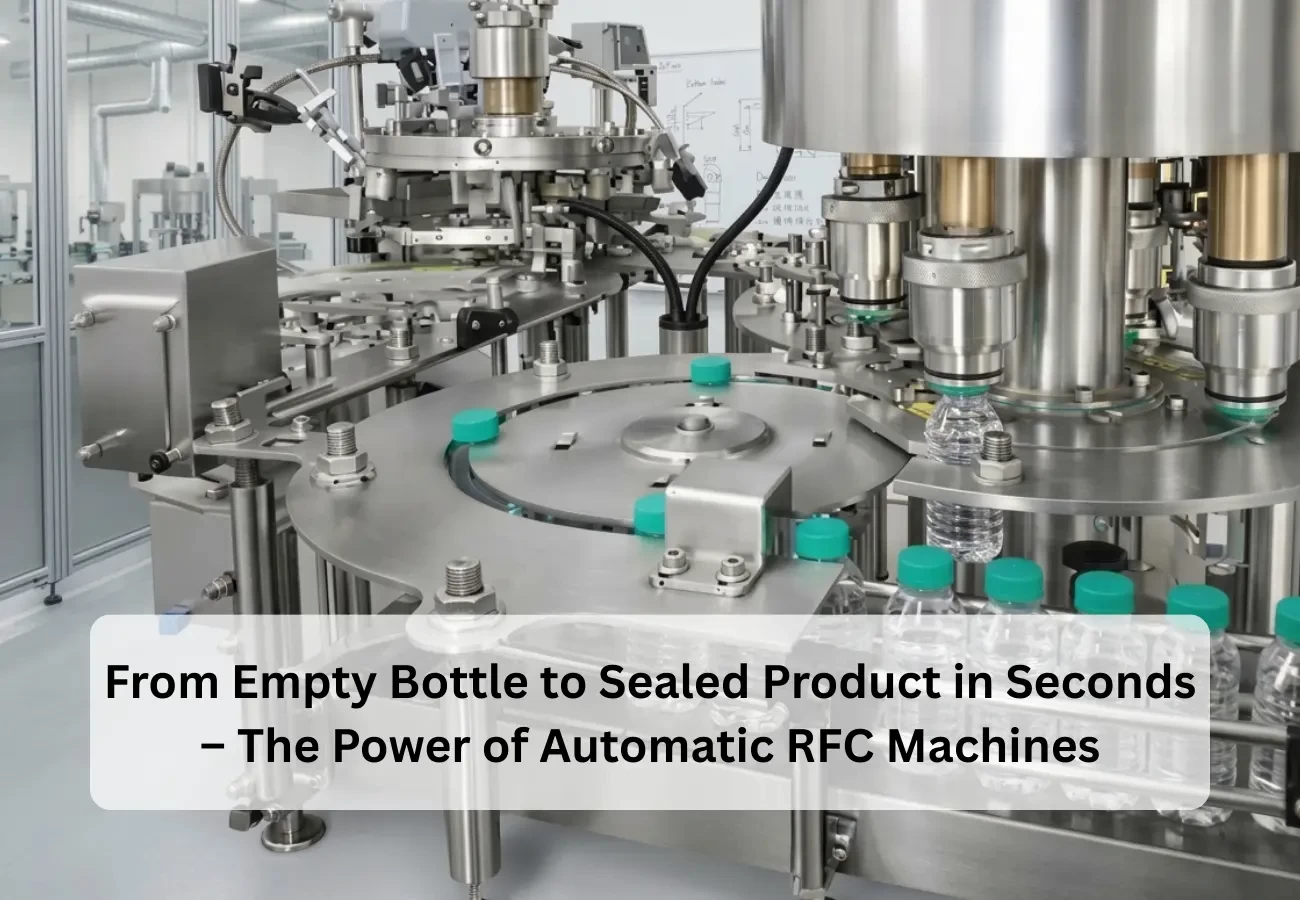

From Empty Bottle to Sealed Product in Seconds – The Power of Automatic RFC Machines
In today’s competitive beverage and packaged liquid industry, speed alone is not enough. Neither hygiene nor efficiency alone is enough. The companies that scale fast combine all three, and that’s exactly where automatic bottle filling machines and Automatic Rinser Filler Capper (RFC) machines change the game.
In just seconds, the automatic liquid filling machine rinses, fills, and seals each bottle, delivering a finished product ready for market.
If your plant is still using a manual or semi-automated system, you’re not only behind, you’re also stunting your growth, losing money, and risking contamination. Conventional systems involve rinsing, filling, and capping in separate machines, with the bottles being manually transferred between machines.
Delays, misalignment, spills, and inconsistencies are common, resulting in production bottlenecks and quality concerns.
The Power of Synchronized Operations
Automatic RFC machines combine all three procedures into a single rotating system. As the turret turns:
- Each bottle is rinsed and automatically inverted.
- Placed immediately beneath filling valves.
- Capped precisely in a single, continuous cycle.
This synchronization helps to eliminate idle time between the stages, increasing the output per hour while minimizing the chances of errors. What does this suggest? It means less dependence on human power, more output, and an uninterrupted flow that human lines cannot achieve.
Integrating an automatic bottle filling machine into your plant ensures that speed and efficiency work hand in hand without compromising hygiene.
Hidden Contamination Risks in Semi-Automatic Lines
While manual or semi-automatic lines may seem more economical initially, they introduce several contamination risks:
- Managing open bottles
- Multiple interactions between personnel during transfers
- Time gaps between rinsing and filling
- Inadequate capping torque
Even a small amount of contamination is enough to cause batch failures, fines, or damage to a company's reputation, especially in the food industry, e.g., in the case of milk, bottled water, juices, edible oil, or pharmaceutical liquids.
Modern RFC machines use stainless-steel contact parts, a closed system, minimal human contact, and hygienic design standards to reduce contamination by shortening exposure time, showing that it is possible to achieve speed and hygiene in bottle-filling machines.
Production Capacity: Manual vs. Automatic
A better comparison would be: for instance, the output of a semi-automatic line could be between 800 and 1,500 bottles per hour, depending on the efficiency of the workers.
As for the output of an automatic liquid filling machine, the following could be achieved:
- 3,000 BPH
- 6,000 BPH
- 12,000 BPH
- 24,000+ BPH
Unlike manual lines, which depend on the efficiency, fatigue, or coordination of the workers, the output of an automatic machine is constant.
Higher production capacity means:
- Faster order fulfilment
- Ability to scale distribution networks
- Lower production cost for every bottle
- Increased profit margins
Making such an investment in an automatic bottle filling machine will ensure efficient manufacturing without compromising quality and production rates.
Water-Saving Rinse Systems: Efficiency Beyond Speed
Modern RFC machines optimize water usage through advanced recirculation systems and rinse nozzles. Instead of continuously wasting fresh water, these systems:
- Apply regulated spray pressure
- Incorporate water recovery systems
- Minimize rinse water consumption per bottle
This improves sustainability metrics and directly reduces operating costs for beverage and bottled water plants. Efficiency in production is not just about speed. It’s about optimizing resources while maintaining high hygiene standards.
Servo-Based Filling Accuracy
Another source of loss is overfilling, which is quite common in bottling plants. Even an overfilling of 2 to 3 ml per bottle may not appear to be a significant amount, but when the plant processes 10,000 bottles per day, it can translate into thousands of liters lost every month.
Contemporary RFC machines use flow meters and servo-driven systems to guarantee precise volume control. As a result, manufacturers benefit from:
- Precise and stable fill levels
- Minimal product loss from leakage or spills
- Greater efficiency across the distribution chain
With an automatic liquid filling machine, accuracy becomes a consistent part of production, reducing waste and boosting profitability.
ROI: Manual vs. Automatic
Many manufacturers hesitate to invest in an automatic RFC machine due to the initial costs. However, the real question is not simply about the price. It’s, “How much is your current system costing you every day?”
Consider the total costs associated with:
- Additional labor
- Restricted production capacity
- Product losses caused by inaccurate filling
- Rejection from contamination
- Water wastage
- Downtime between processes
If we consider the cost savings over 12 to 24 months, an automatic bottle filling machine can actually recover its cost through increased production, reduced losses, and lower operating costs. In fact, the machine is no longer an expense, but an investment.
Conclusion
In the current market, speed, cleanliness, and accuracy are no longer choices, but requirements for business growth and profitability. An automatic RFC machine, along with other modern automatic liquid filling machines, can remove production barriers, contamination risks, and ensure high-volume production.
Are you ready to take your business to the next level, eliminate losses, and increase profitability? If the answer is yes, it might be the right moment to modernize your equipment. Contact Alantech today, and our experts can help you select the right bottle filling machine for your business.
FAQ
- How does Alantech help solve contamination problems in bottling plants?
Alantech provides automatic RFC machines with a closed system and stainless steel contact parts. This reduces human contact and lowers the risk of contamination during production.
- How does Alantech improve production speed in bottling lines?
Alantech installs automatic bottle filling machines that rinse, fill, and cap bottles in one continuous process. This increases production output and removes delays between stages.
- How does Alantech help reduce product loss during filling?
Alantech machines use servo driven systems and flow meters for accurate filling. This helps maintain consistent fill levels and prevents overfilling.
- How does Alantech help manufacturers improve production efficiency?
Alantech integrates modern automatic liquid filling machines that improve speed, reduce labor dependency, and maintain consistent production quality.