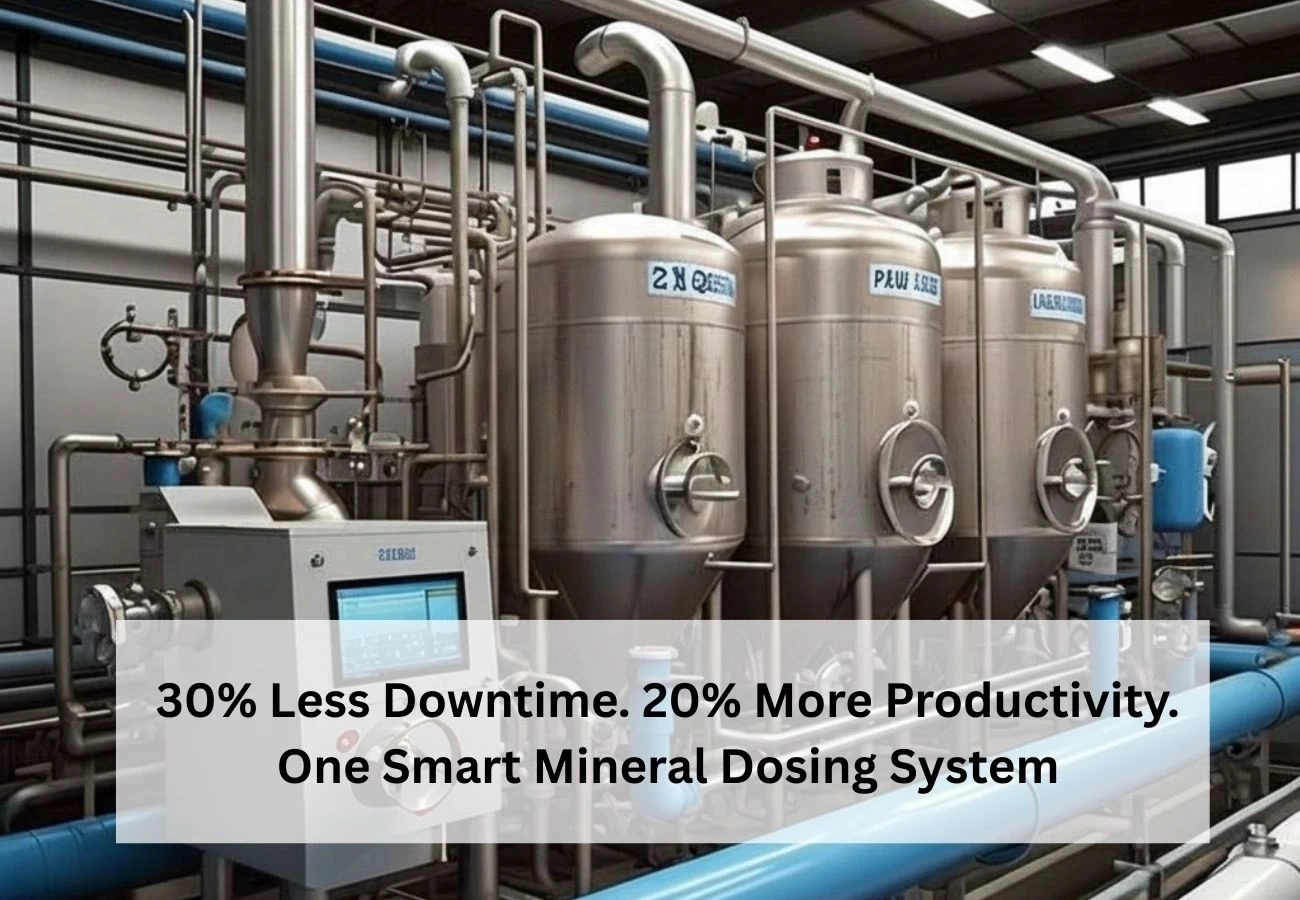

30% Less Downtime. 20% More Productivity. One Smart Mineral Dosing System
In today’s high-demand production environments, maintaining consistency is no longer optional. Even slight inconsistencies in mineral dosing can affect overall plant performance, with consequences for quality, efficiency, and long-term profitability. At the same time, many facilities focus on major equipment and visible failures, while productivity losses caused by inaccurate dosing remain largely unnoticed. Over time, these gaps only grow and reduce output stability and increase operational stress.
Mineral dosing plays a key role in any water treatment solution, particularly in plants where water quality directly influences product taste, regulatory compliance, and equipment health. When dosing is inconsistent, the impact goes beyond a single process stage. System stability is affected, allowing inefficiencies to build up over time.
How Small Dosing Variations Create Big Problems
A variation of just 5 to 10 percent in mineral dosing can disturb production stability. Although such changes may seem small at first, they can change water taste, impact downstream processes, and lead to quality concerns. Manual dosing practices further add to this problem.
Since manual systems are not aligned with real-time flow variations, mineral concentration often fluctuates throughout the day, resulting in inconsistent water characteristics.
In many facilities, mineral dosing is still handled as a standalone activity rather than an integrated part of the raw water treatment plant. When flow rates vary and dosing does not respond in time, overdosing or underdosing becomes inevitable. Overdosing causes scaling and choking in pipelines, filters, and other water treatment components, shortening equipment life by up to 40 percent. Underdosing leads to unstable water quality, increased rework, product rejection, and higher compliance risks.
When these issues are left unaddressed, maintenance moves away from prevention and becomes reactive. Teams are left responding to breakdowns rather than preventing them, driving the plant into a recurring cycle of downtime, urgent repairs, and unnecessary losses.
Why These Losses Multiply Across the Plant
The true cost of inconsistent mineral dosing extends far beyond the dosing point itself. Each hour of downtime can cost thousands, especially in high-throughput operations. Inaccurate dosing affects downstream processes and reduces plant efficiency. At the same time, excess mineral usage increases chemical costs by 15 to 25 percent and equipment wear, doubling maintenance requirements. These challenges are greater in facilities depending on manual operation of water treatment plant components, making scalability and consistency difficult.
In such environments, operators often compensate by increasing monitoring frequency or adjusting parameters manually, which further increases workload and the risk of human error. What starts as a minor dosing inconsistency eventually becomes a plant-wide efficiency problem, affecting productivity, reliability, and long-term asset health.
The Role of Automation in Modern Water Treatment
Modern facilities require a water treatment solution that is responsive, intelligent, and capable of adapting to changing process conditions. Automation plays an important role in achieving this. By integrating mineral dosing with real-time flow data, automated systems ensure consistent concentration levels across varying operational loads.
In a well-designed raw water treatment plant, mineral dosing should work seamlessly with filtration, pumping, and distribution stages. When dosing systems are automated and connected to flow sensors and controllers, they respond to fluctuations, maintaining stable water quality without manual intervention.
This level of integration improves consistency and protects important water treatment components from premature wear caused by scaling, corrosion, or chemical imbalance. Over time, automated dosing becomes a key contributor to plant reliability and cost control.
How Alantech Delivers Measurable Savings and Maximum Uptime
Alantech’s automated mineral dosing systems are designed to eliminate inefficiencies at their root and deliver measurable performance improvements across the plant. By automating the dosing process, Alantech helps facilities reduce process downtime by up to 30%, ensuring smooth and continuous operation even under variable conditions.
With dosing accuracy of ±0.5%, Alantech systems eliminate wastage and prevent quality losses. This level of precision ensures that minerals are added in exact proportions, protecting downstream water treatment plant components and maintaining consistent water taste and composition. As a result, plants experience fewer deviations, fewer complaints, and greater confidence in output quality.
Smart monitoring and predictive alerts further enhance system reliability. By constantly monitoring performance, Alantech systems lower equipment failure risks by over 40 percent. Early alerts enable maintenance teams to take action before breakdowns, reducing unplanned shutdowns and extending the lifespan of key assets.
Optimized Consumption and Energy Efficiency
Optimized dosing directly translates into lower mineral consumption. Alantech’s intelligent control systems reduce mineral usage by 15–20%, giving immediate operational cost savings. These savings compound over time, especially in large-scale facilities where dosing volumes are substantial.
High-efficiency pumps and intelligent controllers improve overall throughput by up to 20%, enabling plants to meet higher production demands without expanding infrastructure. Energy-optimized designs reduce power consumption by 10 to18% annually. This supports both cost reduction and sustainability goals.
In addition, corrosion-resistant materials and low-maintenance designs promise that water treatment components remain reliable over extended operating cycles. Minimized shutdowns and spare part replacements and extended service intervals improve asset utilization and reduce the total cost of ownership.
Beyond Technology: End-to-End Support
Although technology plays an important role, long-term performance depends on well-designed systems and continuous support. Alantech goes beyond supplying equipment by offering end-to-end solutions that include system design, supply, automation, installation, and long-term AMC services.
This holistic approach ensures that every water treatment solution is tailored to the specific operational needs of the facility. Whether integrated into a new raw water treatment plant or retrofitted into an existing setup, Alantech systems are designed for compatibility with existing processes.
Ongoing AMC support ensures consistent performance over time, reducing operational stress for plant teams. With expert support available, facilities can focus on production goals rather than firefighting maintenance issues.
Conclusion
Inconsistent mineral dosing can appear insignificant at first, yet over time it can have serious consequences. Gradually, hidden losses emerge, such as reduced equipment lifespan, increased chemical expenses, frequent downtime, and quality issues. Managing these issues need intelligent automation and integrated system control.
Alantech gives a future-ready approach to mineral dosing by combining precision dosing, smart monitoring, and energy-efficient design. The result is higher uptime, improved productivity, and stable water quality across all operating conditions. For facilities seeking a reliable, scalable, and cost-effective water treatment solution, automated mineral dosing is no longer an upgrade, it is a necessity.