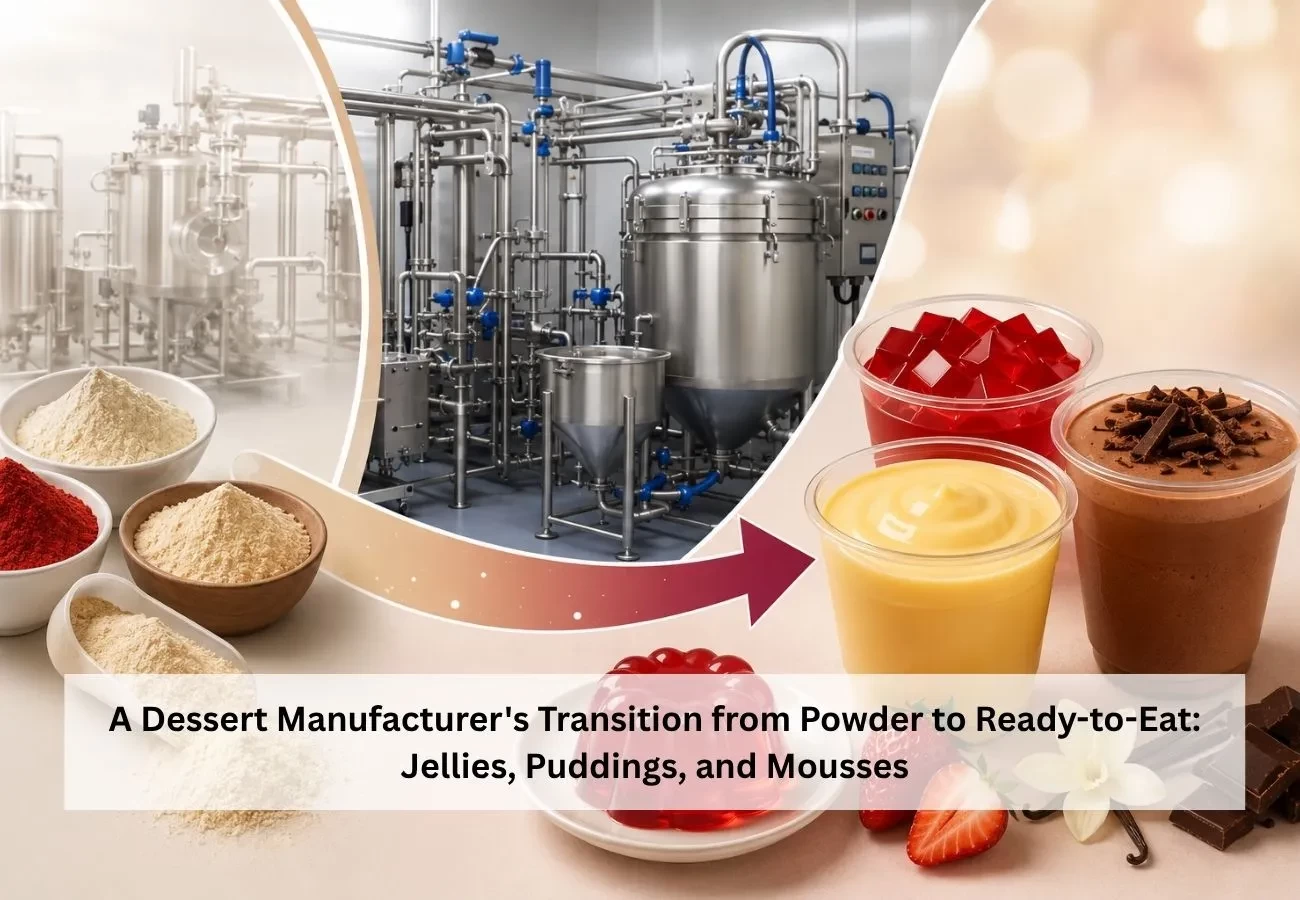

A Dessert Manufacturer's Transition from Powder to Ready-to-Eat: Jellies, Puddings, and Mousses
Food producers are always changing to satisfy shifting consumer needs. Desserts that are ready to eat are becoming more and more popular as consumers seek convenience without sacrificing flavour and quality. A new line of ready-to-eat jellies, puddings, and mousses was introduced by a Portuguese dessert manufacturer with more than 25 years of experience in powdered jelly and dessert preparations.
The Challenge: Expanding Beyond Powdered Desserts
The business was well-known for its powder-based dessert recipes. However, ready-made goods that customers could enjoy right away were becoming more and more popular.
In order to effectively enter this market, the business required:
- A dependable method for completely dissolving powder ingredients
- Jellification under control within containers
- Uniform product quality and texture
- Adaptable production to accommodate various recipes
- Effective hygiene and cleaning practices
This necessitated adding new processing machinery to their manufacturing facility.
The Method: Testing Prior to Investing
Before finalizing the equipment, extensive product trials were carried out in a pilot plant environment to guarantee the best possible outcome.
While being tested:
- Vacuum-suctioned powder ingredients were dissolved in water.
- Depending on the requirements of the recipe, the heating and cooling conditions were changed.
- The behaviour of jellification within containers was confirmed.
- Quality standards and process consistency were verified.
The best production configuration for the new line of ready-to-eat desserts was confirmed by these trials.
The process design followed hygienic engineering principles that are also applied in high purity water system installations, where precise process control as well as product safety are equally important.
The Solution: Installation in Multiple Phases
The installation was created in several stages after the project requirements were assessed:
Stage 1:
Assessment of the Cleaning-in-Place (CIP) system
Stage 2:
- Two more reactors
- Combining two buffer tanks
Stage 3:
Full commissioning and installation of the system
How the Procedure Operates
Complete process control is made possible by the new production line:
- A flow meter is used to introduce water (batch-based control).
- A solids hopper is used to add powders.
- The temperature is regulated according to the recipe (heat, cool, or maintain).
- A mass flow meter is used to move the product to the filling machine.
- Jellification takes place within the container.
This guarantees consistent texture, taste, and consistency throughout batches.
The Outcome
The manufacturer can now do the following with the new installation:
- Make ready-to-eat mousses, puddings, and jellies
- Create unique recipes
- Retain a constant level of product quality
- Accurately regulate the temperature and mixing
- Effectively clean several production lines
The hygienic equipment design also supports efficient cleaning procedures, reducing downtime and improving operational efficiency across multiple production batches, similar to best practices followed in water treatment plant India facilities.
By partnering with INOXPA, the company successfully expanded its product portfolio while ensuring high standards of quality, process control, and hygiene. The tailored solution provided by INOXPA enabled the customer to confidently enter the ready-to-eat dessert market and meet growing demand for convenient, high-quality products
Frequently Asked Questions (FAQs)
Q1: Why are pilot plant trials important before installing a new dessert production line?
A1: Pilot plant trials help manufacturers verify recipe performance, process consistency, and equipment suitability before making a full-scale investment. This reduces production risks and improves product quality.
Q2: Can ready-to-eat dessert production lines be expanded in the future?
A2: Yes. Modern production lines can be designed for future expansion by integrating scalable automation and compatible equipment such as automatic liquid filling machine systems, allowing manufacturers to increase production with minimal disruption.