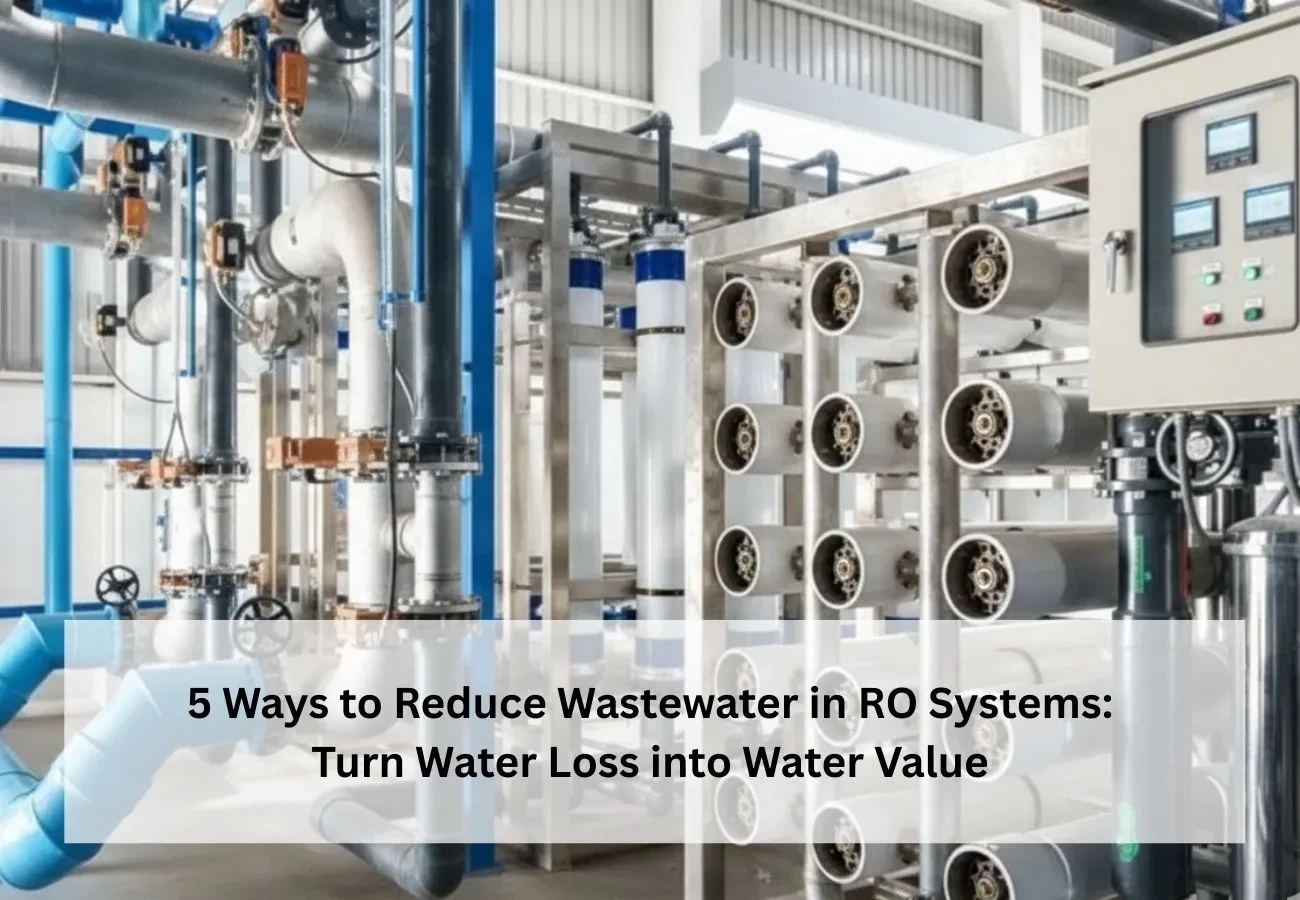

5 Ways to Reduce Wastewater in RO Systems: Turn Water Loss into Water Value
In sectors where water quality is a concern, a reverse osmosis plant is an integral part of ensuring that purification and treatment processes are effective. Nevertheless, many RO plants are faced with challenges associated with the generation of excessive wastewater, especially in the form of RO reject water. This often goes unnoticed until operational efficiency or costs are affected.
Reducing wastewater in an RO system is no longer just an efficiency measure. It has become a necessity for designing cost-effective solutions and ensuring a sustainable, reliable water supply. A well-optimized system protects resources, reduces operational costs, and improves long-term performance.
The Hidden Impact of RO Reject Water
The wastewater produced from RO systems affects operations in the following ways:
- Increased raw water intake, placing pressure on scarce water sources.
- Higher effluent treatment loads, demanding more energy and infrastructure.
- Loss of recoverable water that could be used for other processes.
- Added regulatory and compliance pressure, especially in water-stressed regions.
These factors can significantly increase operational costs. Water procurement, pumping, chemical consumption, and discharge treatment all rise when RO reject volumes are high.
Smarter Systems to Reduce Wastewater in Reverse Osmosis Systems
- Design That Matches Your Water Reality
One of the most common causes of too much reject water is the design of the system without regard to the actual feed water. If a RO water treatment plant is designed with a focus on real water quality, the results will be better, and the amount of waste will be reduced. Proper staging, membranes, and pressure balancing will enable the system to run efficiently without overloading the membranes.
Designing for the water reality of your facility ensures lower reject volumes and higher permeate output. This approach is critical for achieving a high recovery RO system that maintains long-term reliability.
- Pre-treatment That Protects Every Drop
Membranes perform best when protected from fouling and scaling. Pre-treatment systems remove suspended solids, hardness, and organics that can damage membranes. By protecting the membranes from being compromised, operators can safely push higher levels of recovery percentage. This will directly benefit any high recovery RO system while reducing water loss.
A strong pre-treatment system is particularly important for reverse osmosis plants, as it ensures optimum efficiency without compromising water quality or wasting resources.
- High-Recovery RO Configuration
High-recovery configurations, such as multi-stage or two-pass systems, allow plants to harvest a larger share of the available water. Proper pressure, flow, and system control are essential for maintaining membrane integrity while operating at higher recovery rates. Implementing a high recovery RO system ensures maximum water utilization and reduced reject water.
Operators of an RO water treatment plant can benefit from these configurations, as they significantly improve overall water efficiency while lowering operational costs.
- Giving Reject Water a Second Purpose
RO reject water does not always need to be discarded. With smart reuse strategies, it can be redirected for:
- Utility and auxiliary processes
- Cooling applications
- Cleaning and washdown activities
- Landscaping and irrigation (non-potable uses)
Reusing RO reject water reduces fresh water intake, which in turn lowers the total wastewater output. Facilities that integrate reuse strategies into their reverse osmosis plant design can achieve measurable reductions in water loss and enhance sustainability.
- Automation for Water Loss Prevention
Automation is key to maintaining peak efficiency in any RO water treatment plant. Continuous monitoring ensures that the system stays within predetermined parameters, thereby minimizing human error and maintaining the rate of recovery within predetermined limits. The automated system enables the operator to identify any deviation, thus preventing water loss.
How Alantech Ensures RO Efficiency
Alantech integrates wastewater reduction into every stage of its solutions, from design to long-term operations. Their approach emphasizes recovery, stability, and smart resource management.
- Engineered for Higher Recoveries
Alantech’s engineers design reverse osmosis plants based on detailed analysis of site-specific water conditions. This ensures high recovery rates while protecting membrane integrity and maintaining reliability over time.
- Integrated Pre-treatment & RO Solution
Instead of having separate pre-treatment and RO systems, Alantech provides fully integrated solutions. This allows systems to operate in harmony, reducing fluctuations and maintaining stable, lower wastewater levels.
- Reject Recovery and Reuse Solutions
Alantech treats RO reject water as a valuable resource. Recovered water can be reused for auxiliary processes, cooling, cleaning, or non-potable applications. This strategy supports efficient water management and reduces the total load on freshwater sources.
- Smart Control Systems: Efficient Operation
Automation and real-time monitoring are built into Alantech’s high recovery RO systems. This gives optimal performance under varying water conditions and minimizes waste.
- Ongoing Performance Optimization
Water quality and industrial needs change over time. Alantech provides ongoing audits, system upgrades, and performance evaluations to ensure efficiency. Continuous optimization ensures that RO wastewater reduction remains an active, measurable goal rather than a one-time adjustment.
From Water Waste to Water Efficiency
The treatment of wastewater in an RO system is more than just regulatory compliance; it is about optimizing the use of water for your business. By embracing a high recovery RO system and incorporating reuse practices, industries can cut costs, conserve precious water resources, and optimize efficiency.
Alantech’s solutions are centered on RO water treatment plants that provide high recovery rates, low discharge, and reliability. Through proper design, pre-treatment, automation, and recovery, industries can make water work harder while reducing waste.
A well-designed reverse osmosis plant not only meets production and quality goals but also contributes to sustainable water management and regulatory compliance.
Frequently Asked Questions (FAQ)
- What is the ideal recovery rate for a high recovery RO system?
The optimal rate of recovery will depend on the quality of the feed water as well as the design of the system. In many well-designed systems, the rate of recovery will range from 70 to 85 percent, while in advanced systems, it will be possible to achieve even higher rates.
- Can RO reject water be reused safely?
Yes. RO reject water can be reused for non-potable applications such as cooling, cleaning, washdown activities, and landscaping. Proper evaluation ensures it meets the required quality standards for the intended use.
- How does pre-treatment reduce wastewater in a reverse osmosis plant?
Pre-treatment is necessary to remove suspended solids, hardness, and organic substances from water prior to its treatment in reverse osmosis. By doing so, the plant can function at a higher level of recovery with less reject volumes.
- How often should an RO water treatment plant be evaluated for efficiency?
It is advisable to check the efficiency of an RO water treatment plant on a periodic basis, preferably once or twice a year.