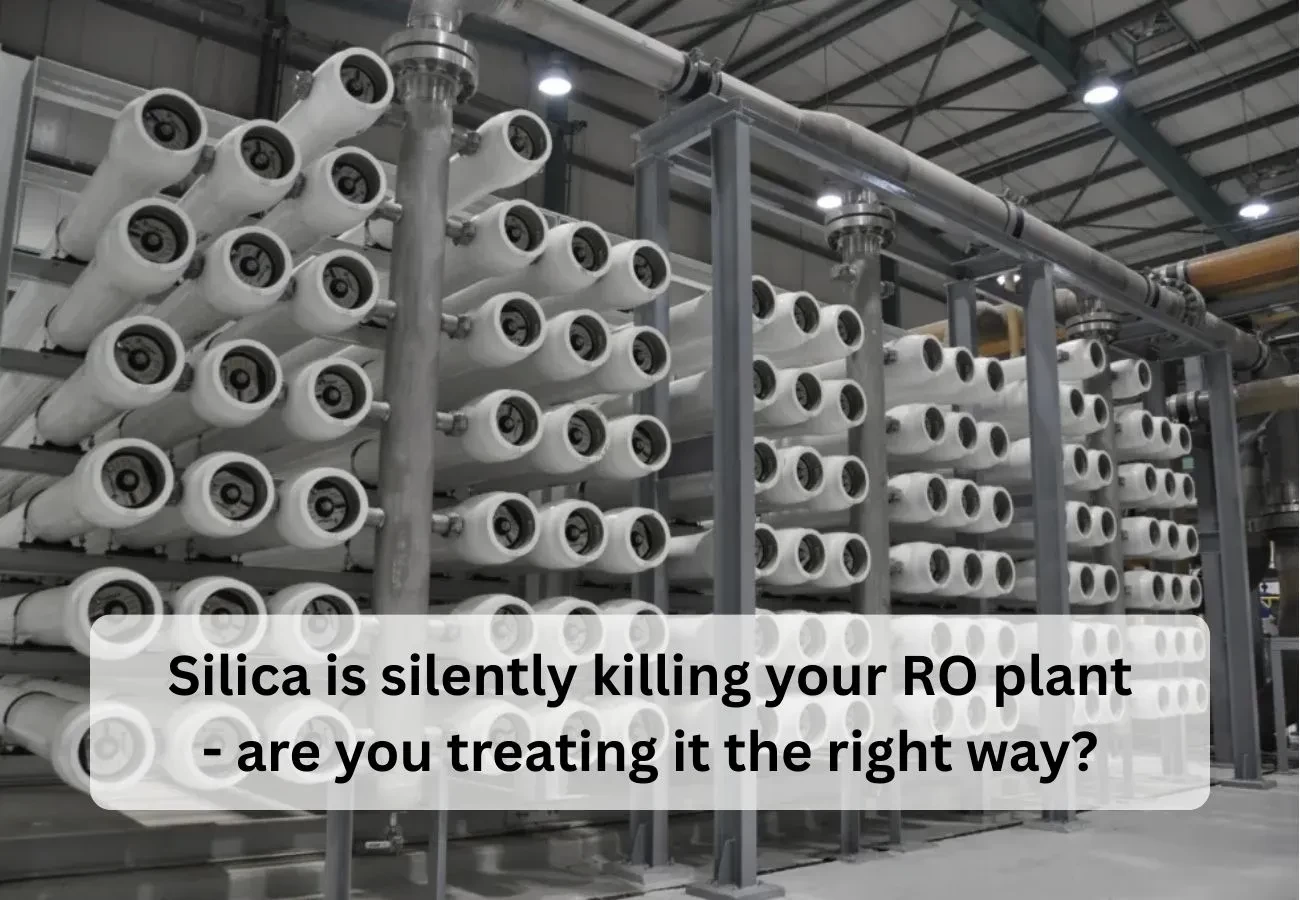

Silica is silently killing your RO plant - are you treating it the right way?
The biggest threat to membrane life within many RO plants doesn’t appear dramatic. There is no visible fouling, no sudden pressure drop, and no alarming colour change in the water. However, the performance gradually slows down, the cleaning cycles are less effective, the energy consumption rises, and the membranes tend to fail much earlier than anticipated.
In most of these instances, the actual problem is silica, which is invisible, underappreciated, and one of the most aggressive membrane-destroying substances in any RO water treatment plant.
At Alantech, a trusted RO plant supplier, we frequently see systems that are perfectly designed for hardness, iron, and turbidity control but quietly losing efficiency because silica was never properly addressed during pretreatment design. Silica scaling is not always obvious in the beginning, which makes it even more dangerous.
Why Silica Scaling Is Far More Dangerous Than Calcium
Unlike calcium carbonate, silica is not readily soluble once it precipitates on the surface of the membrane. Calcium scale can be removed by using acidic cleaning agents. However, silica scale produces a hard, glass-like substance that is not easily removed by acidic or alkaline agents during the CIP process. Once silica scale is formed, the membrane is generally irrecoverable. The damage may not show instantly, but it steadily reduces permeate flow and increases differential pressure.
This is why silica fouling should not be treated as just another scaling issue. It is a membrane life-shortening mechanism that directly impacts the performance and economics of an RO water treatment plant. Failure to consider silica limitations during design may result in frequent replacements of membranes and shutdowns.
Reactive vs. Non-Reactive Silica
Silica in water generally exists in two main forms: reactive silica and non-reactive (colloidal) silica.
Reactive silica is dissolved in water and can contribute to scale formation when concentration and recovery levels rise. Colloidal silica, on the other hand, consists of ultra-fine particles that often bypass multimedia filters and settle gradually on membrane surfaces. These particles are difficult to detect through routine monitoring and may not trigger immediate warning signs.
Both forms are undesirable, but they require different treatment strategies. Many systems fail because the pretreatment design does not differentiate between these two types. Effective water treatment plant consultants understand that silica chemistry must be evaluated before selecting filtration, ultrafiltration, ion exchange, or chemical treatment methods.
When Antiscalant Alone Fails
Antiscalants are often assumed to be a universal solution for scale control. Although they can inhibit silica precipitation under controlled conditions, they have limited operating ranges. Beyond a certain concentration of the product or when the recovery rate reaches a point where maximum output is sought, scaling will happen despite the dosage.
In a real-world scenario, depending on antiscalants without a complete understanding of silica behavior can be misleading. As an experienced RO plant supplier, Alantech has witnessed several instances where high recovery designs exceeded silica concentration limits, leading to early membrane failure.
Antiscalants are only one of several water treatment plant components that must work together within a properly engineered system. Without controlling silica upstream, chemical dosing alone cannot protect the membranes in the long run.
Why pH Correction Is Not a Complete Solution
pH correction is often used to treat scaling. However, silica is different from carbonate scaling. Reducing pH does not reduce dissolved silica in the water. It does not inhibit the precipitation of polymerized silica on the membranes, and in some instances, the lack of proper pH control may lead to the destabilization of colloidal silica.
Silica management involves separation or removal rather than pH control. This is especially critical in large industrial RO water treatment plant installations where operating margins are tight and membrane life directly affects operating cost.
Also Read: Understanding pH Levels in Water Why It Matters for Health and the Environment
Common Pretreatment Design Mistakes
Many RO systems underperform not because of defective membranes but because of inadequate pretreatment design. Mistakes include assuming filters remove silica, neglecting colloidal silica, incorrect calculation of recovery capacity, and designing pretreatment without proper water analysis.
A good supplier of an RO plant needs to analyze the raw water before finalizing the system. The pretreatment system should be designed according to the level of silica and recovery capacity to prevent problems.
Another mistake is poor integration of components in a water treatment plant. Without giving importance to silica removal throughout the plant, the membranes will fail eventually.
Do’s and Don’ts of Silica Management in RO Systems
Effective silica control begins with accurate water analysis. Both reactive and colloidal silica content must be measured, especially in industrial applications. Recovery must be based on silica limits, not just flow targets.
Pretreatment such as clarification, ultrafiltration, ion exchange, or chemical treatment should be selected based on feedwater quality and system design goals. Professional water treatment plant consultants play a key role in evaluating these parameters and recommending suitable configurations.
Operators should not rely only on antiscalants or ignore silica during upgrades, as waiting until fouling appears can cause irreversible damage.
A well-designed RO water treatment plant incorporates silica management at the planning stage, not as a corrective measure after performance decline.
The Alantech Approach to Silica Removal
At Alantech, we design pretreatment systems with silica control at the core of the engineering process. As both a technology-driven RO plant supplier and experienced water treatment plant consultants, we emphasize understanding raw water chemistry before finalizing equipment selection.
Our approach includes detailed water analysis, silica-based recovery design, and the right treatment selection to ensure all water treatment plant components protect membrane integrity, with sustainable operation that prevents irreversible scaling.
Long-Term Benefits of Proper Silica Management
If silica is properly handled, an RO plant will function in an optimal manner with smooth flow, controlled energy consumption, and extended membrane life.
Neglecting silica results in reduced performance, increased costs, and frequent replacement of membranes, particularly in large plants.
An effective RO water treatment plant, designed by experienced water treatment plant consultants and implemented by a trusted RO plant supplier like Alantech, considers silica as a primary design consideration, not a secondary one. When pretreatment and membrane systems are aligned, and when critical water treatment plant components are selected based on accurate chemistry evaluation, membranes can perform reliably for years.
Because when silica is treated the right way, RO plants don’t just operate, they perform reliably, efficiently, and economically over the long term.
Frequently Asked Questions (FAQ)
- How can I identify silica scaling in my RO plant?
Silica scaling will manifest itself as a gradual reduction in permeate flux, an increase in differential pressure, and a decrease in the efficiency of cleaning. Unlike other scales, there will be no return to normal operation following a CIP cycle. A detailed analysis of the water is the best means of identifying silica as the problem.
- Are antiscalants enough to control silica?
Antiscalants can retard silica precipitation within certain limits, but they cannot remove silica from the feedwater. If the recovery rate exceeds the safe levels of silica concentration, scaling will still take place. Proper pretreatment and recovery design are essential.
- Why is colloidal silica difficult to manage?
Colloidal silica is made up of ultrafine particles that tend to bypass conventional filters and gradually accumulate on membranes. It is more difficult to detect and requires special pretreatment techniques such as ultrafiltration or clarification.
- What is the best way to prevent silica damage in an RO water treatment plant?
Prevention starts with accurate raw water analysis, silica based recovery calculations, and selecting better pretreatment methods. Silica management must be integrated into the system design.